
Story · 1985–2003
Why the Shopping Mall Felt Like Its Own World
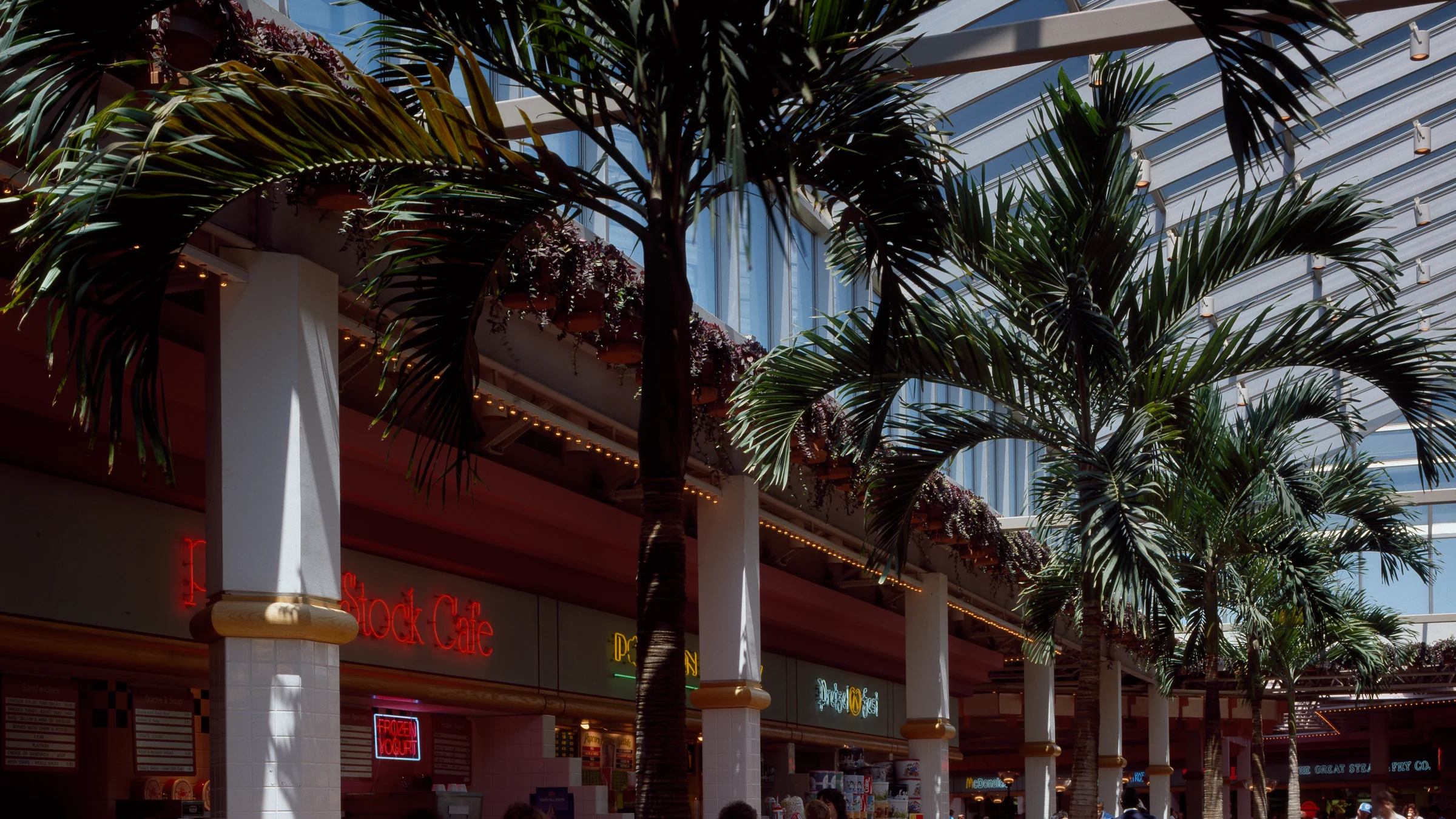
Under artificial skylight, an ordinary afternoon could contain an arcade, a record shop, a cinema and the possibility of meeting everyone you knew.
The doors opened with a breath of conditioned air. Somewhere beyond the tiled entrance, a fountain was already running and a food court was beginning to smell like lunch. The mall was technically a place to buy things. To a child or teenager, it was a climate, a soundtrack and a small city with no rain.
Everything was gathered under one roof
A mall compressed different worlds into a walkable loop. Department stores had their own perfume and carpet. Record shops were dense with colour and headphone stations. Toy shops appeared brighter than their neighbours. A cinema marquee could make the far end of a corridor feel like evening even at noon.
The pleasure came partly from contrast. You could move from the hush of a bookshop to the electronic racket of an arcade in less than a minute.
The architecture made time feel suspended
Skylights, polished rails, indoor trees and fountains suggested public luxury. Clocks were scarce, daylight was softened, and every escalator revealed another level of movement. The building wanted you to wander rather than arrive.
Many malls used the same materials, yet children learned the geography of their local one with extraordinary precision: the shortcut past the photo booth, the bench where parents waited, the shop with the playable console near the entrance.
It was a social network you had to physically enter
Before group chats could reorganise an afternoon, the mall worked as a dependable meeting point. You agreed on a time, chose a landmark and trusted everybody to appear. Once there, you might encounter classmates, older siblings or the person you hoped to see without admitting it.
Being temporarily unreachable created a modest kind of freedom. Parents could be elsewhere in the same building while the arcade, music shop and food court became your own circuit.
Small purchases carried a whole afternoon
Most visits were not shopping sprees. A drink, a magazine, a single CD or a handful of arcade credits could be enough. Browsing did the real work. Objects were encountered in public, held, compared and discussed before they came home.
The carrier bag mattered because it proved the outing had produced something. Even an empty game-shop bag might survive in a bedroom drawer, too attractive to throw away.
What disappeared was more than retail
Online shopping solved the practical task. It did not replace the overlapping public worlds around it: teenagers waiting by a fountain, families negotiating lunch, music leaking from open shop doors. The mall turned consumption into a shared spatial experience.
That is why photographs of old mall interiors can feel uncannily personal. They preserve a stage on which thousands of ordinary, unrecorded afternoons happened.
Every local mall had its own mythology
The supposedly generic building accumulated specific stories. One escalator was always broken. One unit changed tenants so often that nobody used its current name. A seasonal display marked the beginning of December more reliably than the calendar. Children measured growth against the day they were finally allowed to walk the mall without an adult beside them.
Those details explain why a demolished or renovated mall can provoke real grief. The loss is not architectural grandeur. It is the disappearance of a shared coordinate: a place where unremarkable encounters once had somewhere to happen.
Objects in this story
- mall directory
- arcade token
- record-store carrier bag
Loading related film
The archive is loading.
Continue through the archive