
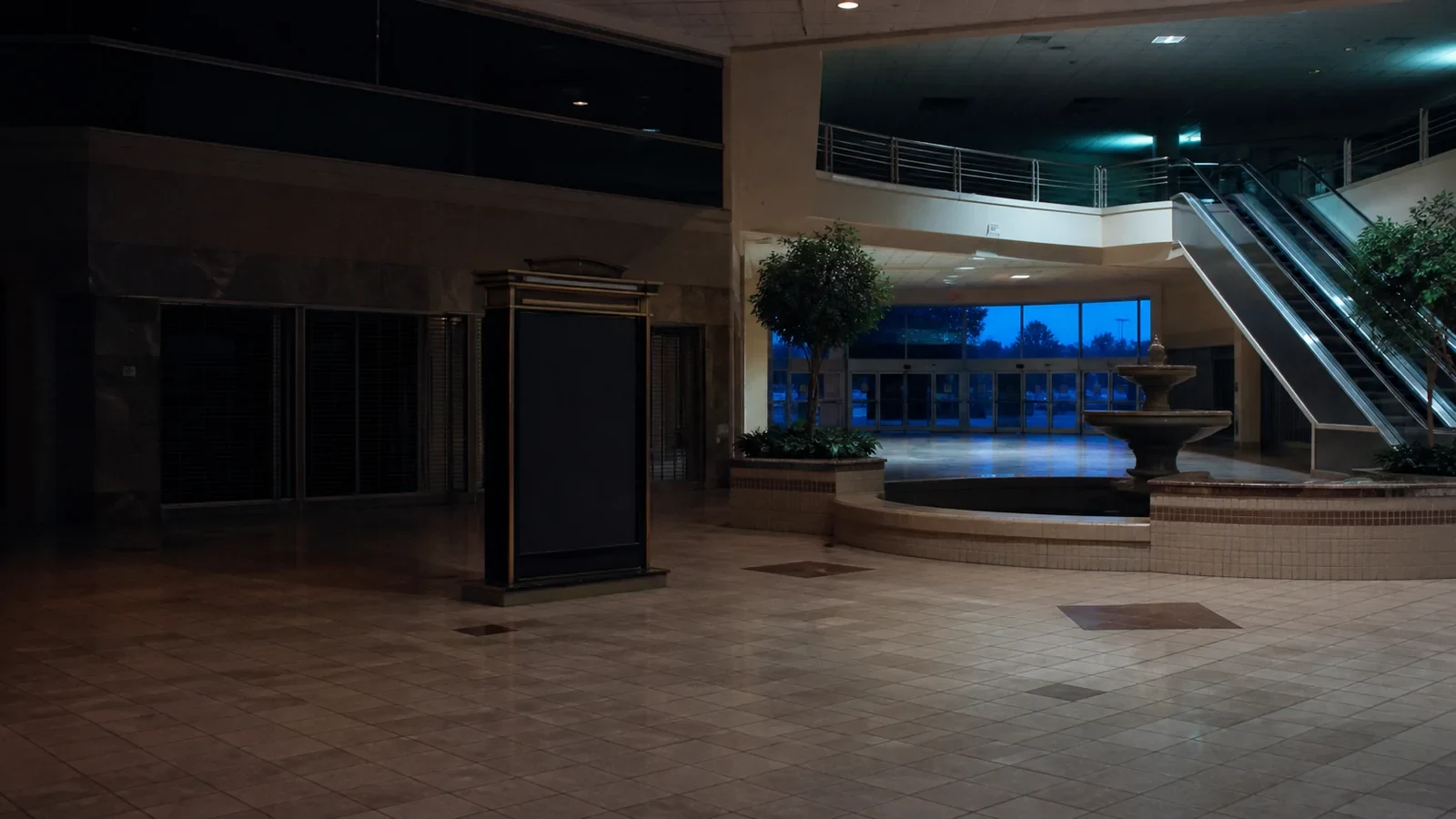
Memory File NMA-007 · 1985–2003
When the Shopping Mall Felt Like the Future
Escalators, fountains and glass ceilings made an ordinary shopping trip feel like entering tomorrow.
Atmospheric reconstruction · Original NMA editorial artwork
The fountain is not beautiful enough to be a destination, yet everybody knows where it is. From there, several afternoons are possible: the arcade, music shop, food court, cinema or simply another slow circuit beneath the skylights. The mall offers freedom, but it has opening hours, cameras and doors owned by somebody else. The scene is not important because everything was better. It is important because the experience had a shape. Waiting occupied time. Objects occupied space. Choices left traces. Even mistakes became part of the route. Commonly, the same outcome may arrive more quickly and with fewer visible steps. That is usually an improvement. But when the steps disappear, the knowledge, rituals and small social negotiations around them can disappear as well. This is the story of a 1990s shopping-mall afternoon: how malls combined freedom, discovery, food, music and games under one roof. It begins with an object or place that once looked completely ordinary, before time turned it into an archive.
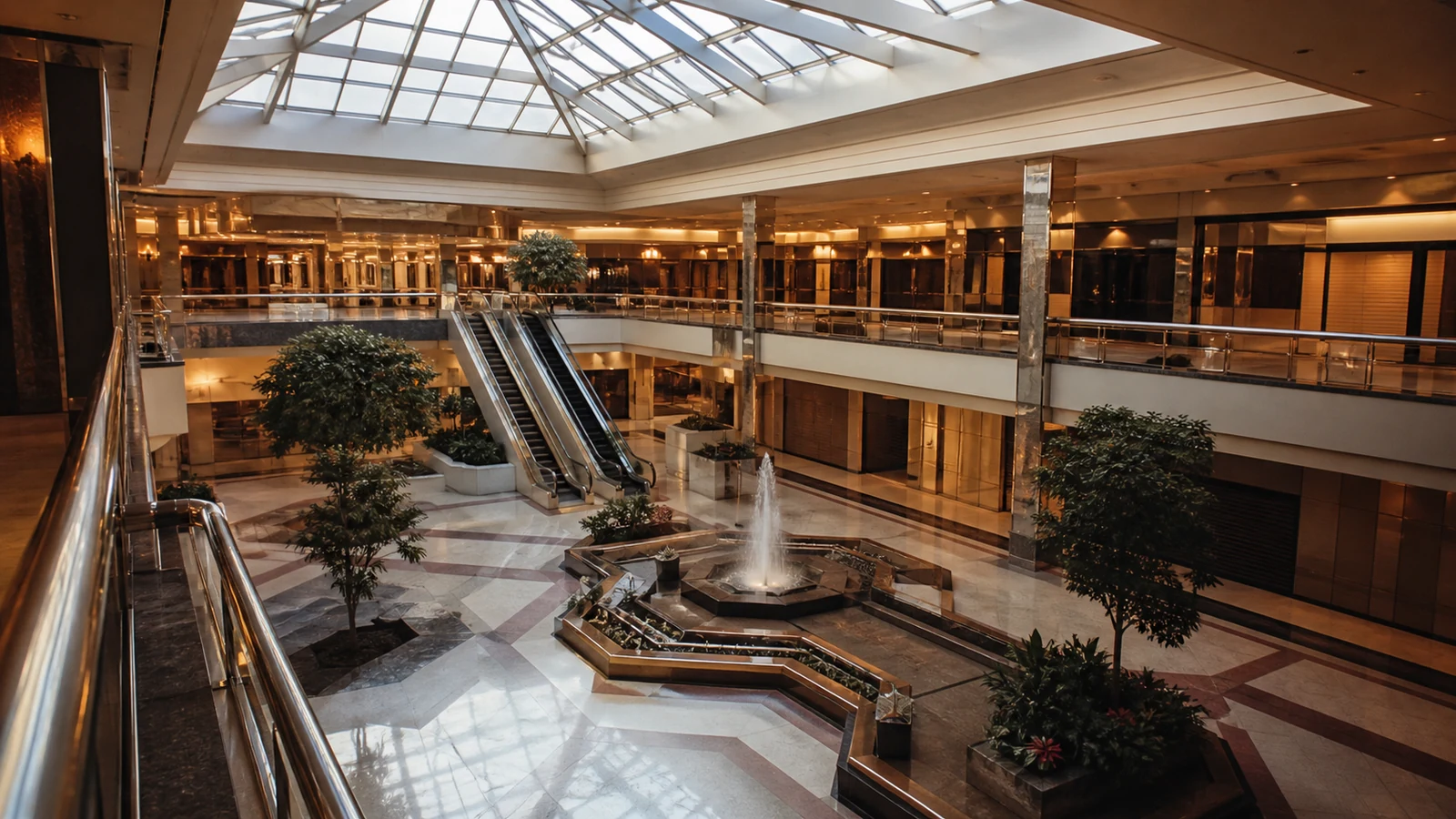
Architecture manufactured an indoor climate
Look closely at a tiled atrium with skylights, fountains, food-court trays and neon shop signs. The remembered future is built from details this modest. Shape, colour, labels and moving parts taught the user what could be touched and what had to be handled carefully. Skylights, tiles, plants, fountains and controlled temperature created a weather-resistant street whose visual cues encouraged movement. Daily use gave this technical detail a recognisable rhythm. Mechanism became habit here. People learned to walk loops, compare prices, spend selectively and use shops as landmarks even without buying, often by watching somebody nearby rather than reading formal instructions. Success was remembered through the action that produced it, while failure taught a different version of the same system. Price, place and personal circumstance altered this part of the story. It is tempting to turn familiarity into a general rule. That would hide people for whom the system was unavailable, confusing or physically difficult to use. Malls excluded through transport, money, surveillance and behavioural rules, while their growth also affected town centres and local businesses. The difference is part of the history, not a footnote. The design detail matters because commercial architecture created a walkable social world while controlling its rules. Music and food gave consumption a shared atmosphere. From there, the story moves towards escalators made circulation theatrical.
Escalators made circulation theatrical
Begin with a tiled atrium with skylights, fountains, food-court trays and neon shop signs. This small scene gives the history a human scale. The mechanism translated an invisible process into delays, noises and small physical signs that users gradually learned to read. Upper levels, balconies and long sightlines let visitors watch one another while moving between shops. For the user, the change appeared first as a practical routine. This part of the story can be measured in gestures. A user would walk loops, compare prices, spend selectively and use shops as landmarks even without buying; then wait for a response and decide what it meant. The pause created room for anticipation, diagnosis and the quiet pride of knowing what to do next. That remembered convenience depended on conditions outside the object. Every convenience described here rested on conditions: ownership, compatible equipment, time and permission to use it. Malls excluded through transport, money, surveillance and behavioural rules, while their growth also affected town centres and local businesses. Remembering the pleasure honestly also means retaining those boundaries. The operation detail matters because commercial architecture created a walkable social world while controlling its rules. The public feeling always rested on private control. A closer look at arriving without an exact purchase felt legitimate reveals what followed.
Arriving without an exact purchase felt legitimate
Imagine a tiled atrium with skylights, fountains, food-court trays and neon shop signs. The object is ordinary here, which is precisely why it matters. People rarely remember a specification sheet. They remember the first successful moment and the room in which a new possibility became real. Young people could browse, meet and walk for hours because the concentration of shops supplied a reason to remain. The mechanism mattered most when it entered an ordinary day. The technical fact entered daily life through routine. Someone still had to walk loops, compare prices, spend selectively and use shops as landmarks even without buying. Because the route was not completely hidden, users acquired practical knowledge about order, timing and care, even when they could not explain the engineering underneath. Not every household encountered this change from the same position. A household with spare media and technical help inhabited another version from one rationing time, money or access. Malls excluded through transport, money, surveillance and behavioural rules, while their growth also affected town centres and local businesses. The object could be liberating and excluding at the same moment. The encounter detail matters because commercial architecture created a walkable social world while controlling its rules. Walking converted retail space into social time. That practical detail opens the way to the loop became the ritual.
The loop became the ritual
Return for a moment to a tiled atrium with skylights, fountains, food-court trays and neon shop signs. Nothing in the scene announces that it will later become history. Repeated actions gave the technology a beginning, middle and end, creating anticipation that instant access often removes. Repeated circuits allowed friends to encounter others, reconsider purchases and stretch a limited budget into an afternoon. This was where an abstract feature became a familiar action. What looked like inconvenience also acted as an interface. The need to walk loops, compare prices, spend selectively and use shops as landmarks even without buying divided the experience into recognisable stages. Each stage could be taught, shared, interrupted or remembered, giving the technology a rhythm of its own. The limits become clearer when the memory is viewed beyond one room. Regional releases and personal circumstances prevent one universal reconstruction. Malls excluded through transport, money, surveillance and behavioural rules, while their growth also affected town centres and local businesses. The archive therefore holds several overlapping pasts instead of one perfect childhood. The ritual detail matters because commercial architecture created a walkable social world while controlling its rules. Anchor stores organised an indoor geography. The same history continues through pocket money drew a boundary.
Pocket money drew a boundary
Look closely at a tiled atrium with skylights, fountains, food-court trays and neon shop signs. The remembered future is built from details this modest. Capacity, battery life, bandwidth, fragility or time did not merely obstruct use; the limit influenced choices and attention. Food, arcade credits, music and clothing competed, making price comparison and window-shopping central to the experience. People understood the system through what it asked them to do. Ordinary expertise accumulated around pocket money drew a boundary. To walk loops, compare prices, spend selectively and use shops as landmarks even without buying was to participate in a sequence shaped by the device's limits. People adapted with notes, containers, favourite settings and advice passed across the room. Participation still depended on money, confidence and compatible surroundings. Even at its most common, the technology was not neutral. Design assumptions shaped who could operate it independently, and economics shaped who could practise. Malls excluded through transport, money, surveillance and behavioural rules, while their growth also affected town centres and local businesses. The constraint detail matters because commercial architecture created a walkable social world while controlling its rules. Music and food gave consumption a shared atmosphere. Its social consequences emerge more clearly in the mall created semi-supervised independence.
The mall created semi-supervised independence
Begin with a tiled atrium with skylights, fountains, food-court trays and neon shop signs. This small scene gives the history a human scale. Even a personal device depended on borrowing, teaching, showing, recommending and negotiating space with other people. Parents could choose a meeting time while security, staff and indoor boundaries made the environment appear manageable. Its meaning accumulated through small actions repeated over time. The user did not encounter the system as theory. They encountered a task: walk loops, compare prices, spend selectively and use shops as landmarks even without buying. Over time the task became almost automatic, but its physical order remained available to memory long after the underlying product had disappeared. The familiar version was only one among several possible experiences. Memory often smooths away the barrier once somebody learned to cross it. Yet the barrier mattered. Malls excluded through transport, money, surveillance and behavioural rules, while their growth also affected town centres and local businesses. The improvement offered by later systems should be judged alongside the ritual that was lost. The social detail matters because commercial architecture created a walkable social world while controlling its rules. The public feeling always rested on private control. The next layer of the experience is the food court mixed choice and standardisation.
Sources & evidence
Documentary record
Library of Congress
Open source recordLibrary of Congress
Open source record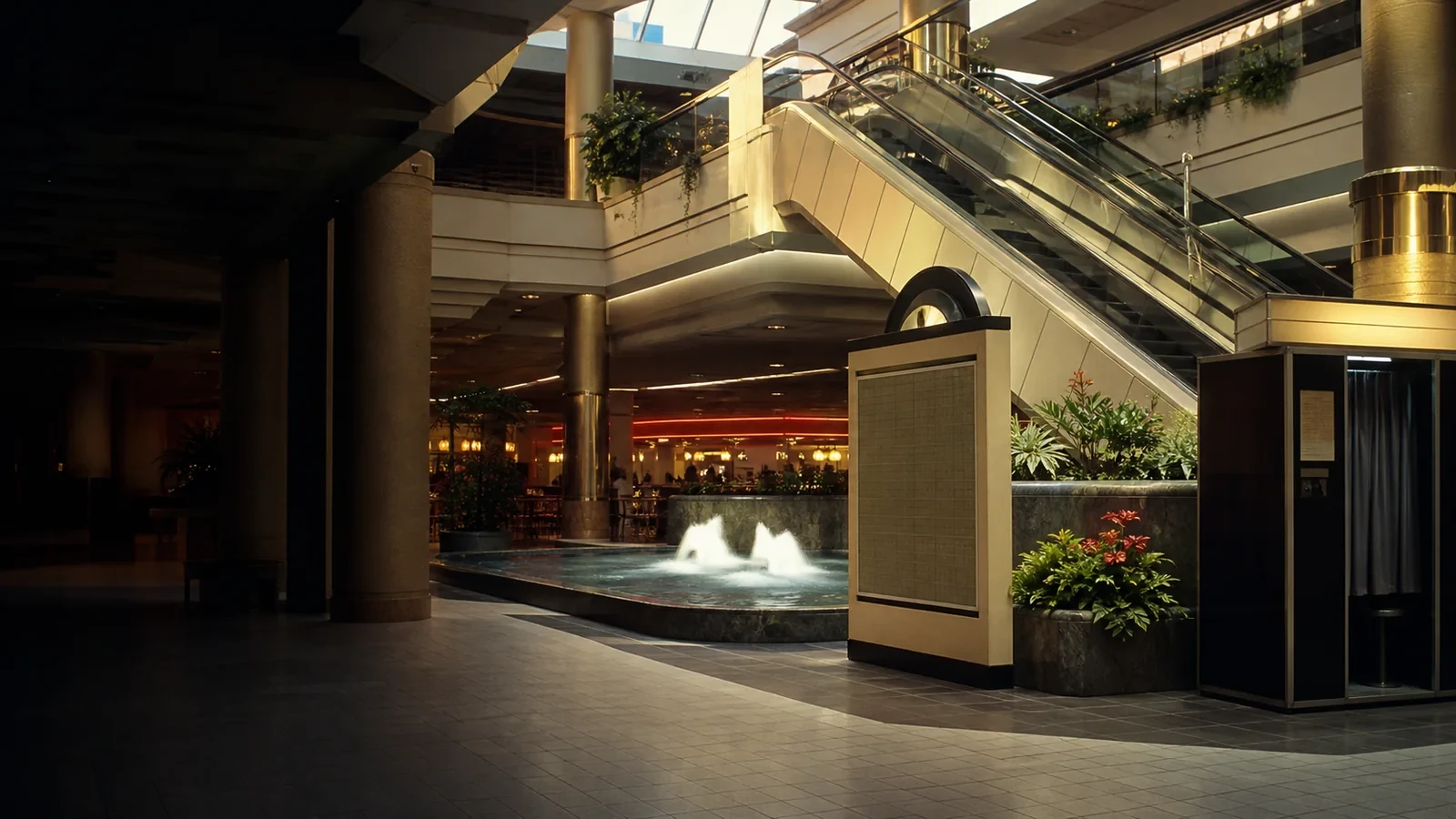
The food court mixed choice and standardisation
Imagine a tiled atrium with skylights, fountains, food-court trays and neon shop signs. The object is ordinary here, which is precisely why it matters. Buttons, errors, sounds and brand names became shorthand, allowing users to share knowledge before formal digital help was always available. Shared seating surrounded branded counters, letting groups buy different meals while remaining together. The everyday sequence made the larger change easier to recognise. The consequence appeared in behaviour. To use a 1990s shopping-mall afternoon, somebody had to walk loops, compare prices, spend selectively and use shops as landmarks even without buying. The sequence made decisions visible: what to choose, what to keep and whether the result justified the effort. Knowledge lived in small repeated acts, not only in manuals. A different body, budget or household could produce another memory entirely. Access was never evenly distributed. Reliable equipment, money, language and patient help changed the experience, while shared rooms or inaccessible controls narrowed it. Malls excluded through transport, money, surveillance and behavioural rules, while their growth also affected town centres and local businesses. The language detail matters because commercial architecture created a walkable social world while controlling its rules. Walking converted retail space into social time. That language prepares us for music and fashion stores sold identity.
Music and fashion stores sold identity
Return for a moment to a tiled atrium with skylights, fountains, food-court trays and neon shop signs. Nothing in the scene announces that it will later become history. The remembered object sat inside a wider economy of wages, gifts, rentals, second-hand sales, blank media, subscriptions and repair. Listening stations, posters, displays and staff knowledge turned retail into exposure to cultural signals that travelled back to school. What looked technical from outside became habitual from within. Music and fashion stores sold identity changed the user's next move. The ordinary task was to walk loops, compare prices, spend selectively and use shops as landmarks even without buying, but repetition turned that task into confidence. A labelled case, memorised sequence or patient second attempt could matter more than an impressive specification. The pleasure and the barrier often existed at the same time. The familiar version belongs to only part of the audience. Different prices, bodies, households and markets produced different memories. Malls excluded through transport, money, surveillance and behavioural rules, while their growth also affected town centres and local businesses. Nostalgia can record attachment without proving universality. The economy detail matters because commercial architecture created a walkable social world while controlling its rules. Anchor stores organised an indoor geography. The economic reality comes into view through security defined who belonged.
The mall became a complete leisure circuit
Imagine a tiled atrium with skylights, fountains, food-court trays and neon shop signs. The object is ordinary here, which is precisely why it matters. At the cultural peak, the technology stopped looking remarkable and became background infrastructure for ordinary days. Multiplexes, arcades, food and retail allowed several forms of entertainment without returning outdoors. Normal use translated the design into a pattern people remembered. The technical fact entered daily life through routine. Someone still had to walk loops, compare prices, spend selectively and use shops as landmarks even without buying. Because the route was not completely hidden, users acquired practical knowledge about order, timing and care, even when they could not explain the engineering underneath. The popular image becomes more honest when its exclusions remain visible. A household with spare media and technical help inhabited another version from one rationing time, money or access. Malls excluded through transport, money, surveillance and behavioural rules, while their growth also affected town centres and local businesses. The object could be liberating and excluding at the same moment. The peak detail matters because commercial architecture created a walkable social world while controlling its rules. Walking converted retail space into social time. At its cultural peak, the story becomes e-commerce and changing cities altered the model.
E-commerce and changing cities altered the model
Return for a moment to a tiled atrium with skylights, fountains, food-court trays and neon shop signs. Nothing in the scene announces that it will later become history. The successor was usually faster, smaller or easier. Nostalgia becomes useful only when those improvements are acknowledged directly. Online retail, overbuilding, department-store consolidation and new mixed-use strategies produced decline in some malls and reinvention in others. The practical ritual made the promise visible without explaining it. What looked like inconvenience also acted as an interface. The need to walk loops, compare prices, spend selectively and use shops as landmarks even without buying divided the experience into recognisable stages. Each stage could be taught, shared, interrupted or remembered, giving the technology a rhythm of its own. Ownership was only one condition; time and permission mattered as well. Regional releases and personal circumstances prevent one universal reconstruction. Malls excluded through transport, money, surveillance and behavioural rules, while their growth also affected town centres and local businesses. The archive therefore holds several overlapping pasts instead of one perfect childhood. The replacement detail matters because commercial architecture created a walkable social world while controlling its rules. Anchor stores organised an indoor geography. What replaced it is easier to understand through photographs preserve design but not circulation.
Photographs preserve design but not circulation
Look closely at a tiled atrium with skylights, fountains, food-court trays and neon shop signs. The remembered future is built from details this modest. Hardware can survive while batteries, belts, services, displays, software and knowledge disappear around it. Dead-mall archives capture architecture and signage, while the density, sound and informal routes of a busy afternoon are harder to retain. By then, the operation itself had become part of the memory. Ordinary expertise accumulated around photographs preserve design but not circulation. To walk loops, compare prices, spend selectively and use shops as landmarks even without buying was to participate in a sequence shaped by the device's limits. People adapted with notes, containers, favourite settings and advice passed across the room. Later convenience solved barriers that nostalgia can easily smooth away. Even at its most common, the technology was not neutral. Design assumptions shaped who could operate it independently, and economics shaped who could practise. Malls excluded through transport, money, surveillance and behavioural rules, while their growth also affected town centres and local businesses. The preservation detail matters because commercial architecture created a walkable social world while controlling its rules. Music and food gave consumption a shared atmosphere. Preservation brings us to the memory is a place to be unfinished.
The memory is a place to be unfinished
Begin with a tiled atrium with skylights, fountains, food-court trays and neon shop signs. This small scene gives the history a human scale. The lasting memory comes from the relationship between a limited system and the imagination people supplied to complete it. The mall allowed young people to spend time between destinations, even though that freedom remained entangled with buying and private ownership. The final meaning rested on an action that once felt unremarkable. The user did not encounter the system as theory. They encountered a task: walk loops, compare prices, spend selectively and use shops as landmarks even without buying. Over time the task became almost automatic, but its physical order remained available to memory long after the underlying product had disappeared. The closing memory must therefore hold both attachment and limitation. Memory often smooths away the barrier once somebody learned to cross it. Yet the barrier mattered. Malls excluded through transport, money, surveillance and behavioural rules, while their growth also affected town centres and local businesses. The improvement offered by later systems should be judged alongside the ritual that was lost. The meaning detail matters because commercial architecture created a walkable social world while controlling its rules. The public feeling always rested on private control. The story now returns to its opening image.
Audiovisual archive
Watch the memory
The Behind the Scenes Secrets of Shopping Malls
A concise history of shopping-mall design, including the spatial ideas behind the enclosed mall and Victor Gruen’s influence.
Open on YouTube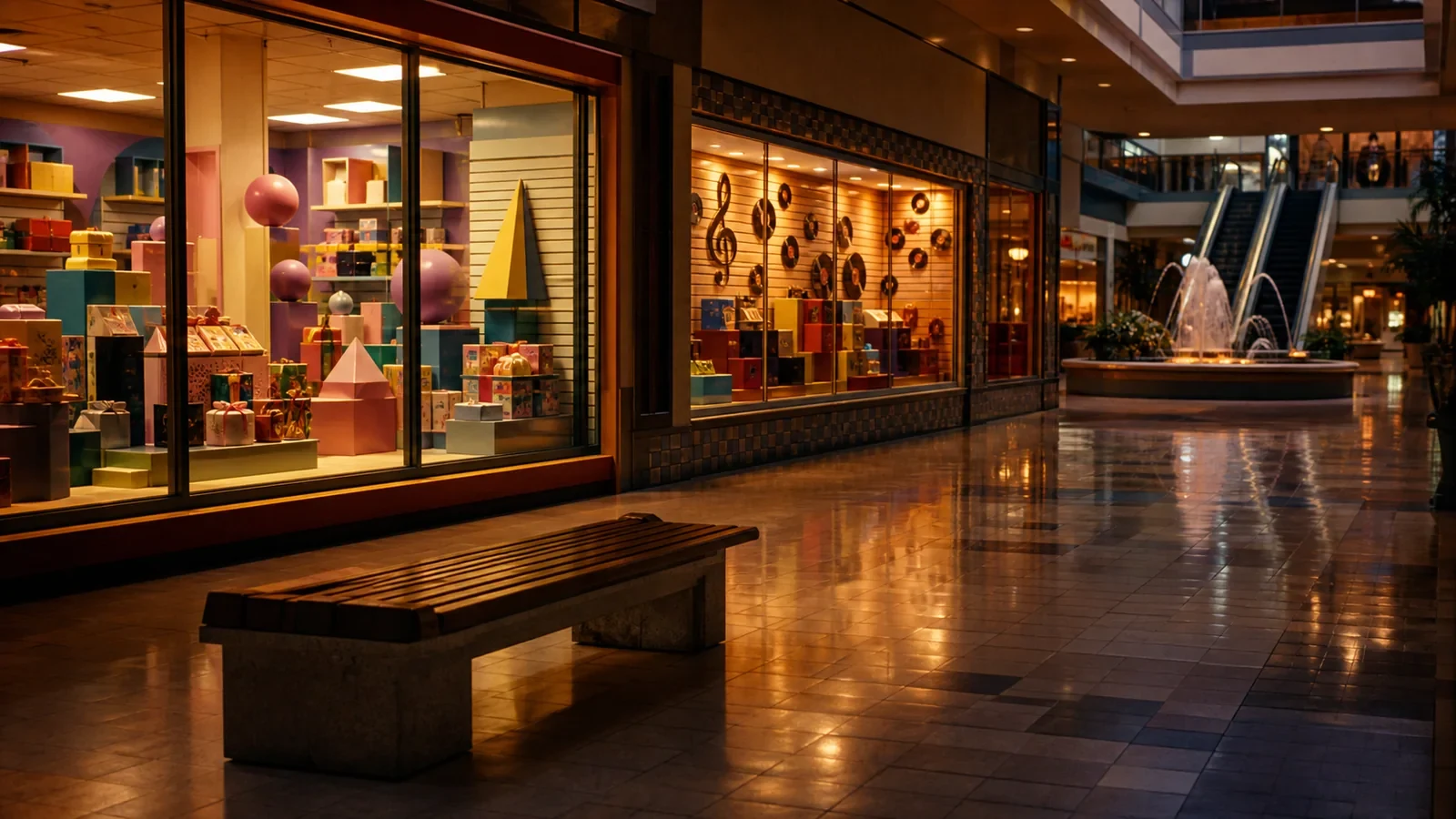
What remains
The final announcement moves through the atrium. Chairs are stacked, shutters descend and the fountain continues circulating water for an audience that has gone. The indoor town returns to being a building.
a 1990s shopping-mall afternoon did not vanish in a single moment. It became less necessary, then less visible, and finally old enough to be remembered as a world of its own. The successor removed genuine frustrations. It also changed the rhythm through which attention, anticipation and ownership had been expressed.
That is why the feeling survives. Not because every limit was precious, and not because every childhood had access to the same things, but because ordinary people built meaning around a limited system. They learned its sounds, its failures and its possibilities until using it felt like a small form of belonging.
The object may now sit silent. The place may have changed beyond recognition. Yet the old sequence can still return in an instant: a movement of the hand, a mechanical sound, a particular colour of light.
For a moment, the future is waiting there again.
---
Memory prompt
What detail do you remember?
Not the product alone—the room, the waiting, and the small rule that made the moment yours.
Archive note
This Memory File is open through the governed release registry. Reconstruction imagery is labelled separately from documentary references.