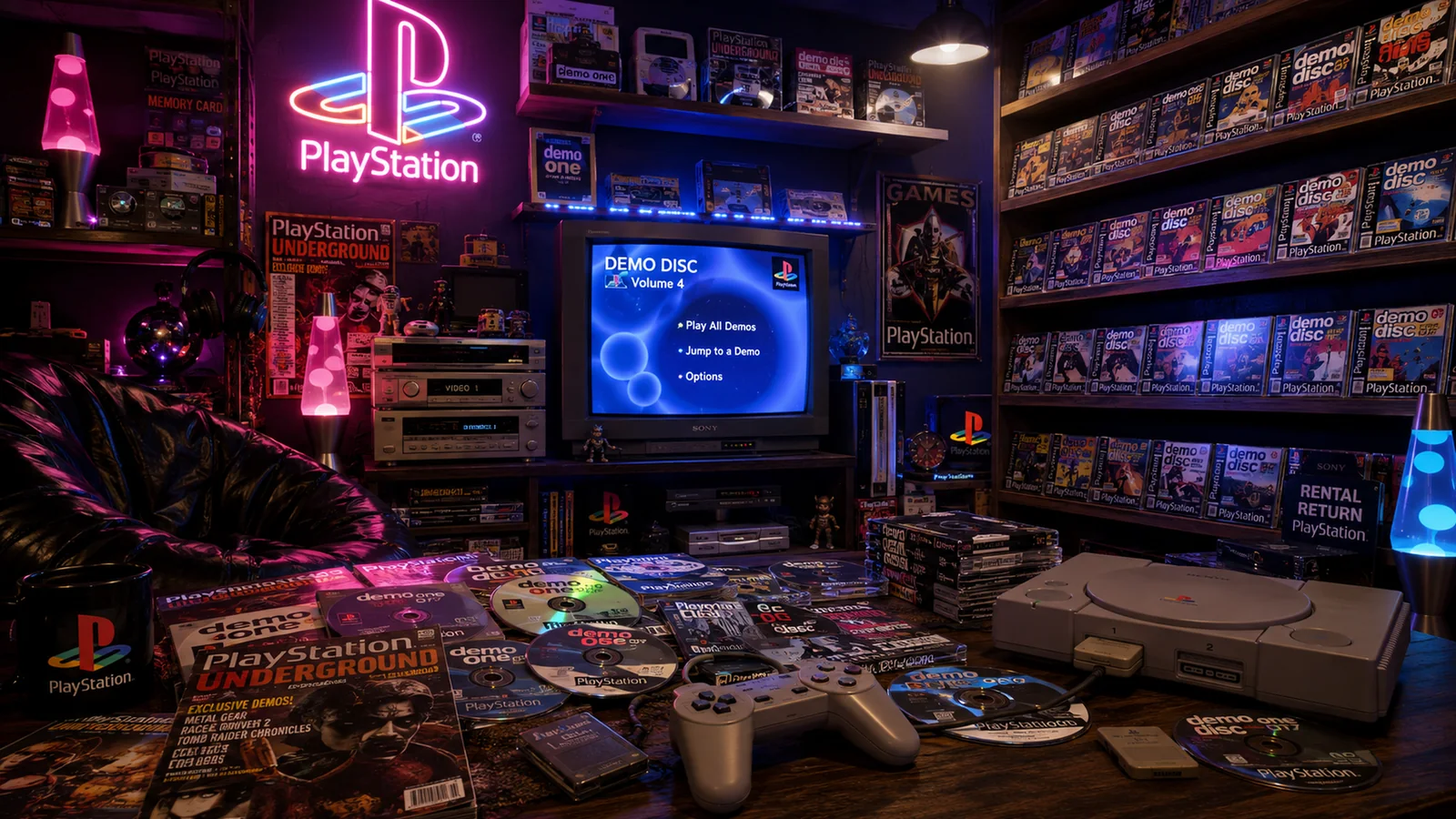
A demo disc was designed to be incomplete. That was precisely why it could hold a month: one race, one level, one menu track, and the larger game still waiting somewhere beyond the ending.
Opening scene
The level that always ended
The ending was always in the same place.
Perhaps it waited beyond a corner, after one last opponent, or at the end of a lap learned almost perfectly. The screen faded. A message thanked you for playing. Then came a release date, a magazine score, or a reminder that the complete game could be found in shops.
There was nothing more to unlock. So you pressed start and played it again.
The route was no longer unknown, but that did not make it empty. Repetition revealed a faster line through a corner, an item hidden behind the obvious path, a move that had seemed accidental until it could be performed on purpose. When the demo stopped offering progress, the player began inventing other reasons to continue.
A disc might contain several such fragments: a single race, one arena, ten minutes inside a story that would continue without you. Between them sat videos of games that could not be played at all, their worlds visible but sealed behind the menu.
A demo disc was a sales tool. But for a generation of players, the thing designed to be incomplete became complete enough to remember for the rest of their lives.
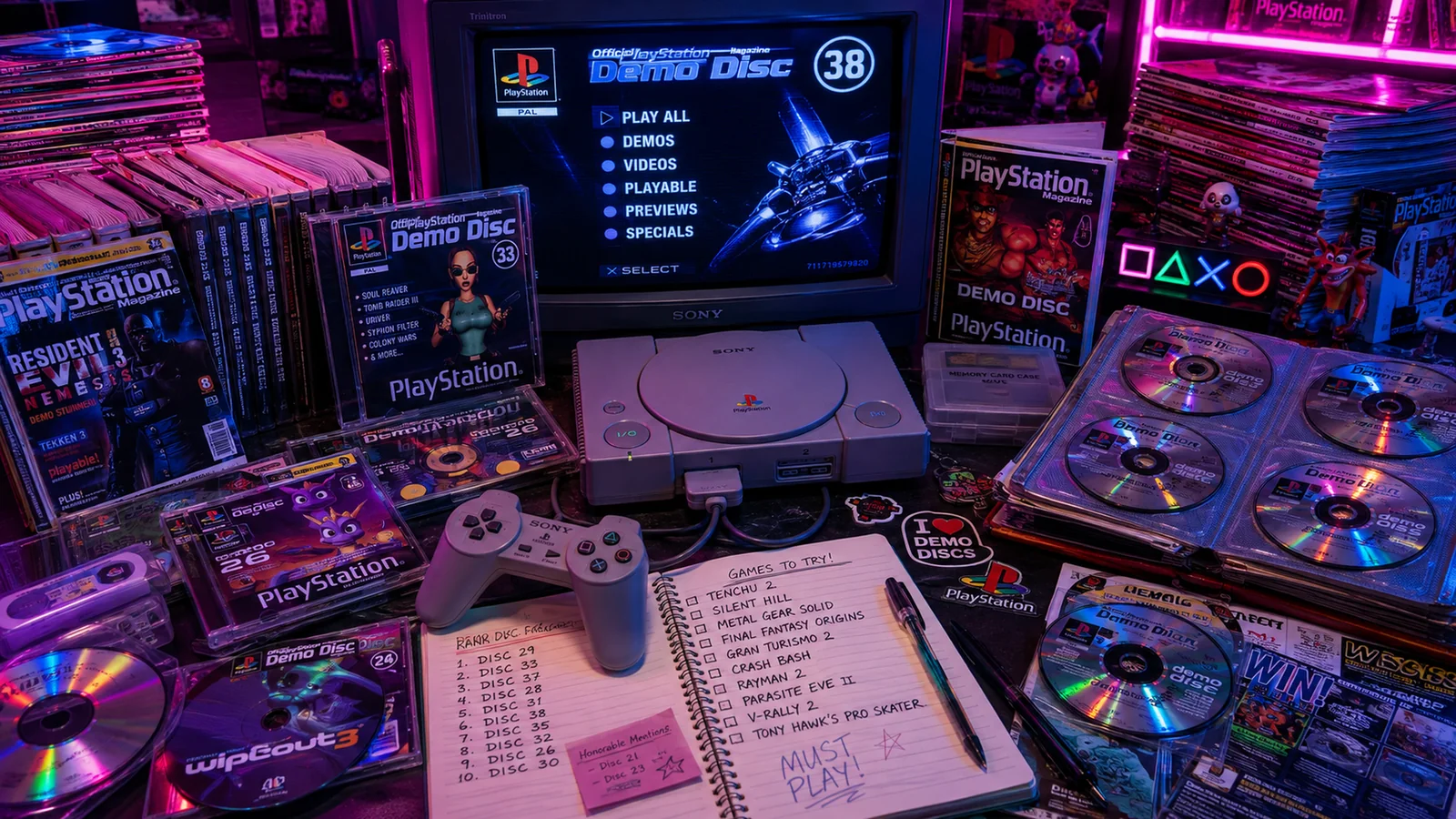
Not a catalogue of objects: a room arranged around the question of what the disc might contain.
- Place
- Bedroom floor, living-room carpet or the journey home from a magazine rack
- Object
- A cover disc, sampler or demo collection in a sleeve or jewel case
- Ritual
- Unwrap, insert, wait, explore the menu, replay the favourite fragment
- Sound
- CRT hum, disc spin, menu loop and controller buttons
- Texture
- Glossy disc surface, creased magazine paper, brittle cases and fingerprints
- Feeling
- Anticipation made larger by not knowing
The object
A whole month inside one disc
The magazine rack offered its own kind of preview. Before the pages could be opened, covers competed through colour, screenshots and large promises. Attached to the front — sometimes in a clear sleeve or behind a cardboard panel — was the object that changed the magazine from something to read into something to play.
The printed surface carried several game names, arranged as though all of them might somehow fit into the afternoon ahead. The list mattered, but the mere presence of the disc mattered too. It gave the magazine weight. It moved slightly beneath the wrapping. On the journey home, it was possible to feel exactly where it sat.
Then came the practical sequence: remove the wrapping without damaging the magazine, free the disc from its sleeve, turn on the television or computer, and wait for the machine to read it. A disc holding five small demos did not feel like five limitations. It felt like five unopened possibilities.
Official PlayStation Magazine discs could mix playable samples, videos of upcoming games and, at times, software made through Sony's Net Yaroze development programme. The exact mixture changed, which meant the menu itself had to be explored.
The ritual
Finding, loading, choosing, replaying
There was usually reading to do first, although impatience did not always allow it. Pages described the games waiting on the disc. A preview might explain the controls or the point at which a playable section had been taken from the full release. Screenshots supplied context for areas the sample would never show.
Print and disc therefore formed a loop: read, play, return to the page, notice something previously overlooked, play again. The magazine could become a manual for fragments drawn from several unrelated games.
One month was long enough for favourites to form. Long enough for menu music to stop being background and become familiar. Long enough for a single level to acquire routines its designers had never needed to imagine. When the next issue arrived, the old disc did not necessarily disappear; it joined a stack of beginnings.
Documentary evidence
The material that made the promise physical
One verified object can ground the memory without turning the page into a product catalogue. The dark data side of a PlayStation-format CD-ROM records the distinctive physical medium beneath demo-disc discovery; archive records document the magazine-specific discs separately where image rights remain reference-only.
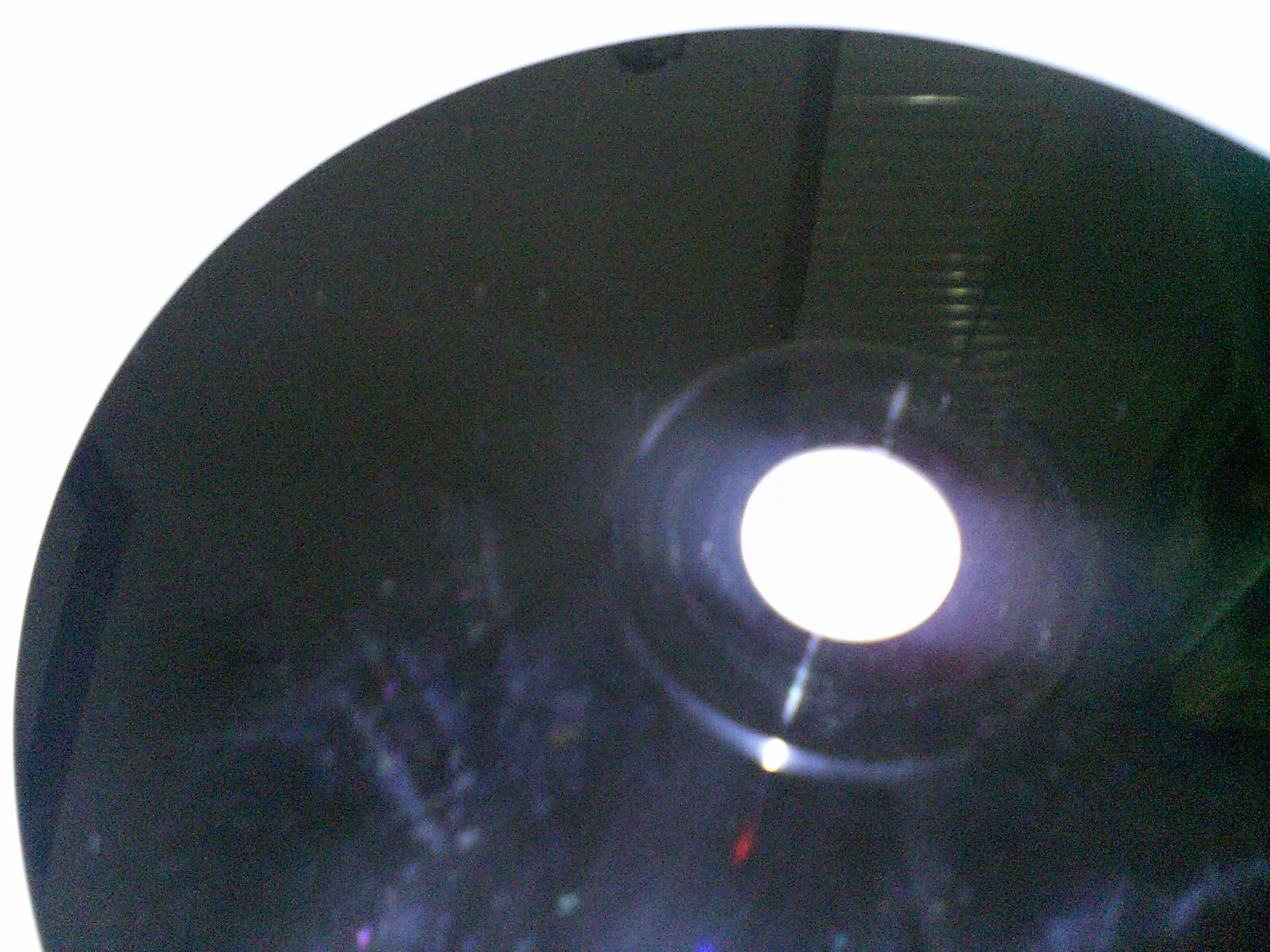

July 1998 · SCED-01144 · playable demonstrations including Bomberman World, Colin McRae Rally, Gran Turismo and Klonoa.
Source & rights ↗The playable fragment
Why a few minutes felt enormous
Once a demo became familiar, progress stopped being the only measure of play. The intended route might take ten minutes. After several attempts it could be completed in eight, then seven. Corners were cut more tightly. Enemies were avoided or defeated in a different order. The boundary remained fixed, but the path towards it became personal.
A racing demo could produce an almost endless argument with the clock. Platform and adventure demos invited less formal experiments: could a high ledge be reached, was there anything behind the starting area, would the game react if the obvious instruction was ignored?
The software might contain fifteen minutes of new material. Play could extend across weeks because novelty was gradually replaced by familiarity, and familiarity by mastery. A player could know the demo level better than someone who owned the full release and passed through it once.
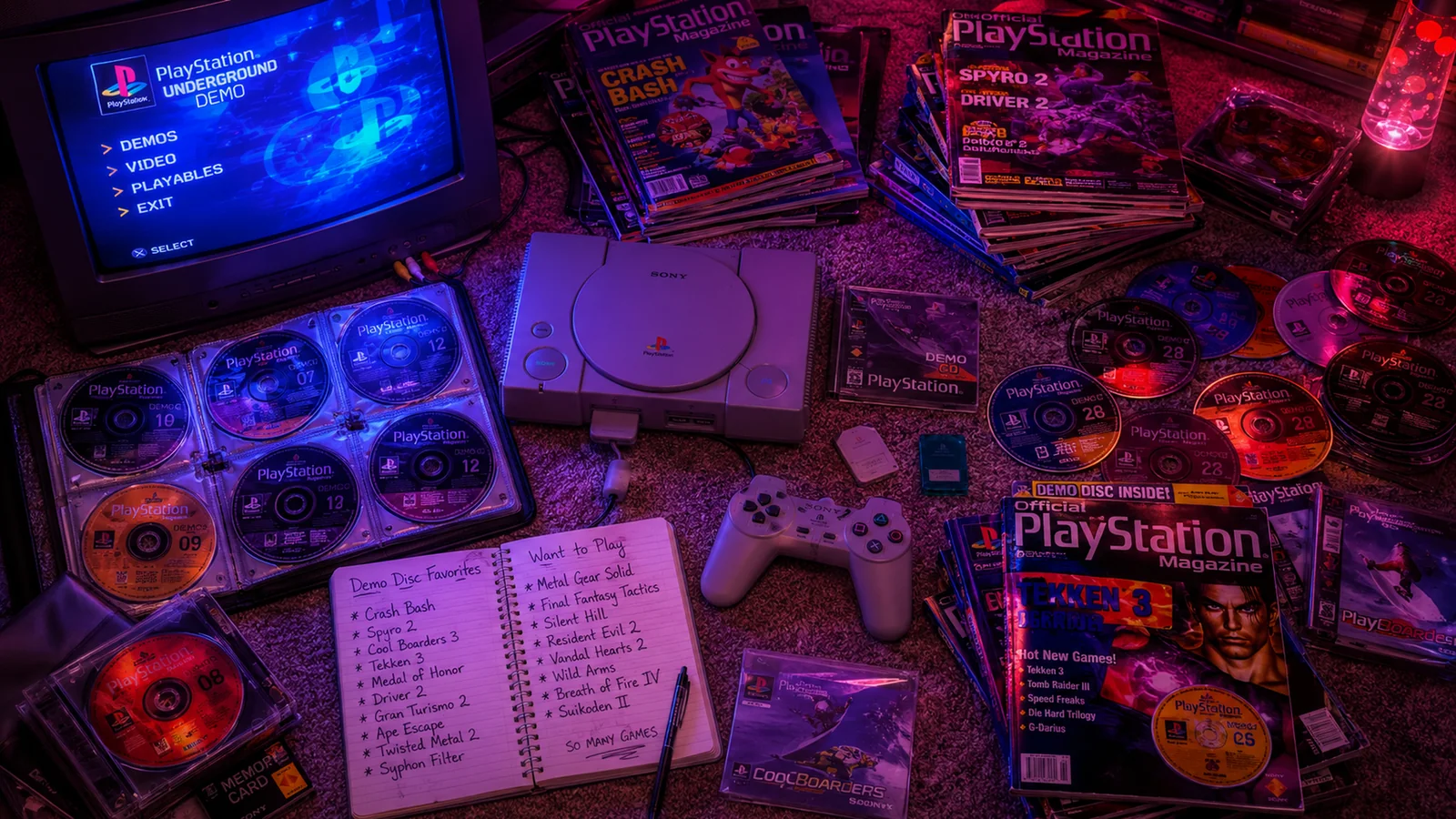
Fragments become a private library: numbered discs, magazine stacks and the glow of a menu that never changes.
Things you probably forgot
Small details at the edge of the disc
- The menu music had to survive indecision. Selection could take time, and the same loop returned after every sample.
- Not every menu door opened to a game. Some led only to a trailer, screenshots or a feature that made the unavailable game feel larger.
- The disc could arrive inside a magazine. It made a publication into a hybrid object: part journalism, part catalogue, part playground.
- Scratches changed the atmosphere immediately. A tiny mark on the surface could turn anticipation into a careful cleaning ritual.
- A tiny level slice could outlast a full game. The boundary became a familiar destination, not merely an interruption.
- Stacks gathered from everywhere. One disc came with hardware, another with a magazine, another from a friend whose original sleeve had vanished.
Watch the memory
Four windows into sampler culture

The first disc promise
Demo One [Version 1] [Europe] [1995]
An era-correct look at the early bundled-disc format: a small physical object standing in for a much larger catalogue.
Watch on YouTube ↗
A disc becomes its own event
PlayStation Underground Jampack (1998)
Playable samples, previews and menu space collected into one branded object rather than one game.
Watch on YouTube ↗
The format keeps changing
PlayStation Underground Jampack Winter 2001
A later sampler shows how demos, trailers and platform culture continued to share a single disc.
Watch on YouTube ↗
The platform finds its voice
Society Against PlayStation (SAPS) — 1995
An official period advertisement for the cultural atmosphere in which these small discs travelled.
Watch on YouTube ↗Video players load only after an explicit click and use YouTube’s privacy-enhanced domain.
Cultural context
The disc mattered because it was incomplete
The cover disc connected direct experience with editorial authority. A magazine could recommend a game, but a playable sample let the reader test the feeling within a carefully rationed portion. The player could hesitate, make mistakes, ignore the objective or spend five minutes testing a door.
That agency made the fragment personal. Two people could receive the same level and come away with different stories because one had found a route the other missed. The commercial message might be identical, but the experience was not.
Some discs arrived through magazines, others with hardware, through promotions or from friends. Their labels recorded different origins; domestic use erased those distinctions. All of them became part of the same improvised library.
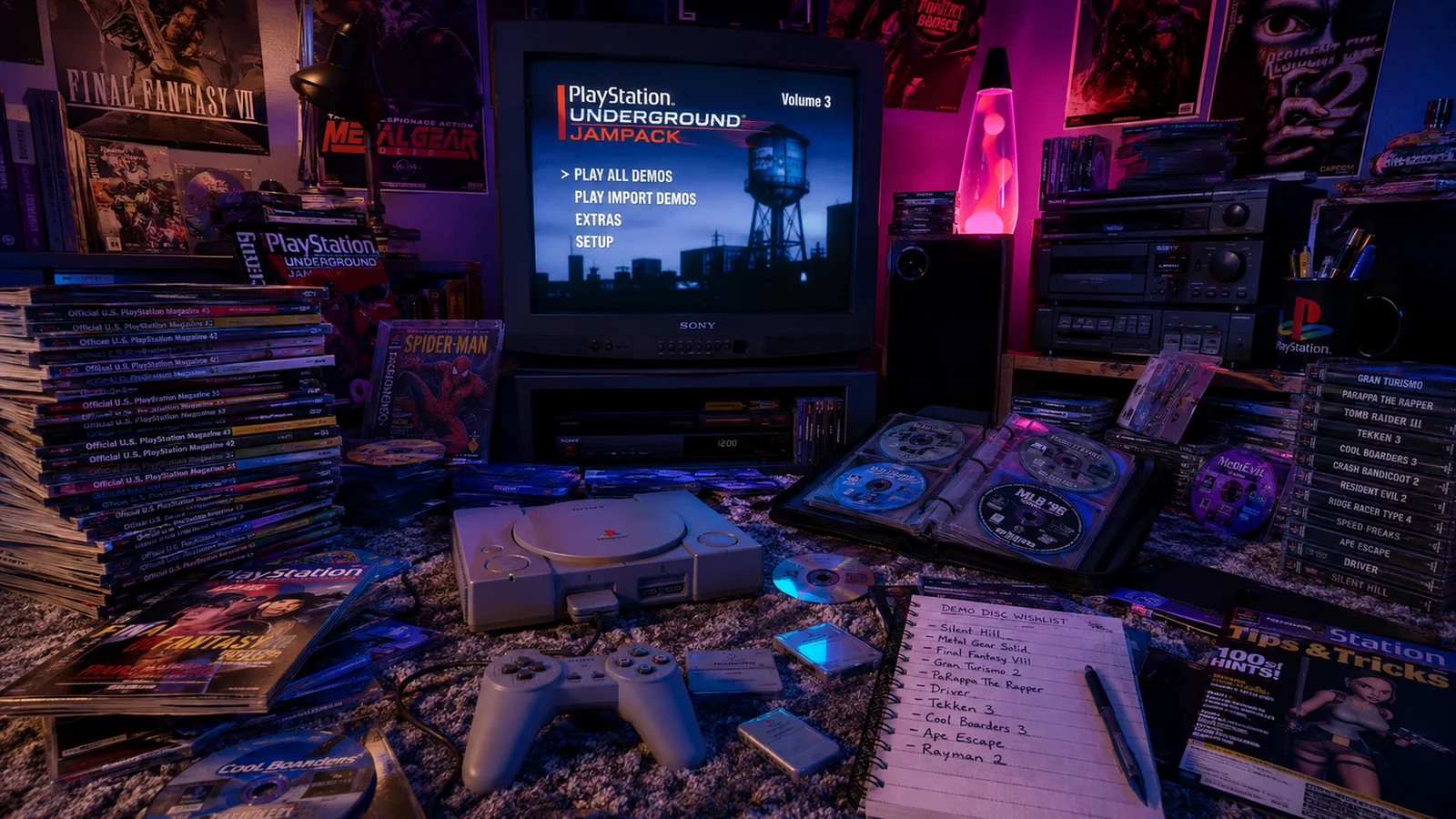
A return to the room after the menu: piles, light, fragments and more worlds than the afternoon could contain.
one dated collection set the limits: a disc, a menu, a magazine, and the next issue still weeks away.
trials, trailers, storefronts and full playthroughs are instantly available, but fewer objects remain to carry the waiting home.
Memory prompt
Which demo did you keep playing after it had already ended?
Which disc, menu song or single playable fragment became larger than the game it was advertising?
Think about the route home, the magazine on the floor, the first option you chose, and the one you only tried after everything else had been exhausted. The full game may have remained unknown. The beginning is enough.
Sources & archive note
Evidence behind the memory
This Memory File distinguishes original NMA atmospheric reconstructions from documentary evidence. Historical claims draw on documented magazine-disc, sampler and shareware references in the NMA-002 source set; copyrighted magazine scans remain citation-only until reuse rights are cleared.
Last editorial verification: 22 August 2026
Documented sources and archive records
- PlayStation CD-ROM photograph by PiaCarrot, CC BY-SA, via Wikimedia Commons ↗
- Centre for Computing History — Official UK PlayStation Magazine Disc 17 Vol 2 ↗
- Centre for Computing History — Official UK PlayStation Magazine Disc 38 ↗
- Lost Releases — Official UK PlayStation Magazine CD 40 documentation ↗
- The Strong National Museum of Play collections ↗