
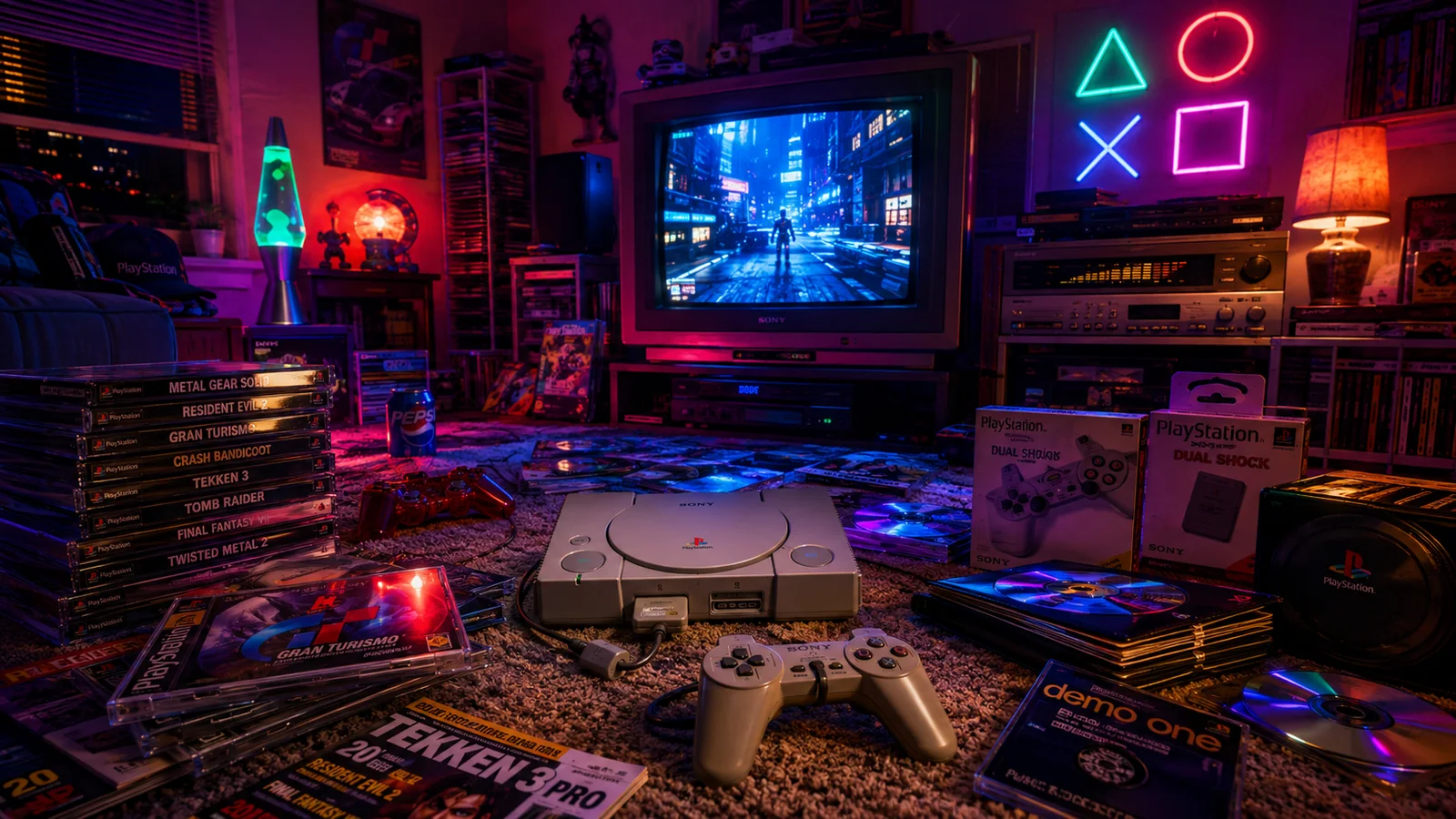
The first PlayStation made the future feel physical: a low grey machine beneath a glowing CRT, a reflective disc in your hand, a controller cable across the floor, and a startup sound that made an ordinary room feel briefly larger than itself.
Opening scene
Before the game, there was the wait
The television was already on.
Its curved glass caught a faint reflection of the room: the lamp in the corner, the edge of a cabinet, maybe someone sitting on the carpet closer to the screen than they were supposed to. Beneath it sat a low grey console with a circular lid. An open jewel case lay nearby. A controller cable stretched across the floor in a line that quietly decided where the player could sit.
There was a sequence to starting a game.
Press the button. Lift the lid. Take the disc from its case by the edge. For a second the underside flashed a rainbow under the room light. Press it onto the spindle. Close the lid. Check the controller. Check the memory card. Press power.
Then wait.
For a moment the television seemed almost empty. The room was still the same room, but attention had shifted completely toward the screen. Then the startup sound arrived: low, controlled, enormous compared with the tiny television speakers producing it. It moved from reassurance into something stranger and brighter. A few seconds later the game would take over, but those first seconds belonged to the machine itself.
That was part of what made the first PlayStation feel futuristic. Not because it looked like a spaceship. It did not. It was restrained, almost sober. The future came from the contrast: an ordinary family television, ordinary carpet, ordinary furniture — and beneath it a machine that suddenly made 3D worlds, CD-ROMs, rendered intros and unfamiliar new game spaces feel domestic.
The future had entered the house, but it was still something you could touch.
Software had a shiny surface. Progress lived on another small piece of plastic. The controller was connected by a cable. The lid moved under your hand. Even waiting was visible.
- Place
- Bedroom carpet or family living room in front of a CRT
- Object
- Original Sony PlayStation
- Ritual
- Open lid, place disc, close lid, press power, wait
- Sound
- Startup sequence, disc mechanism, television hum
- Texture
- Pale-grey plastic, glossy jewel cases, reflective CD-ROM
- Feeling
- Anticipation mixed with a little uncertainty
The object
A console that did not look like a toy
The original PlayStation was surprisingly restrained.
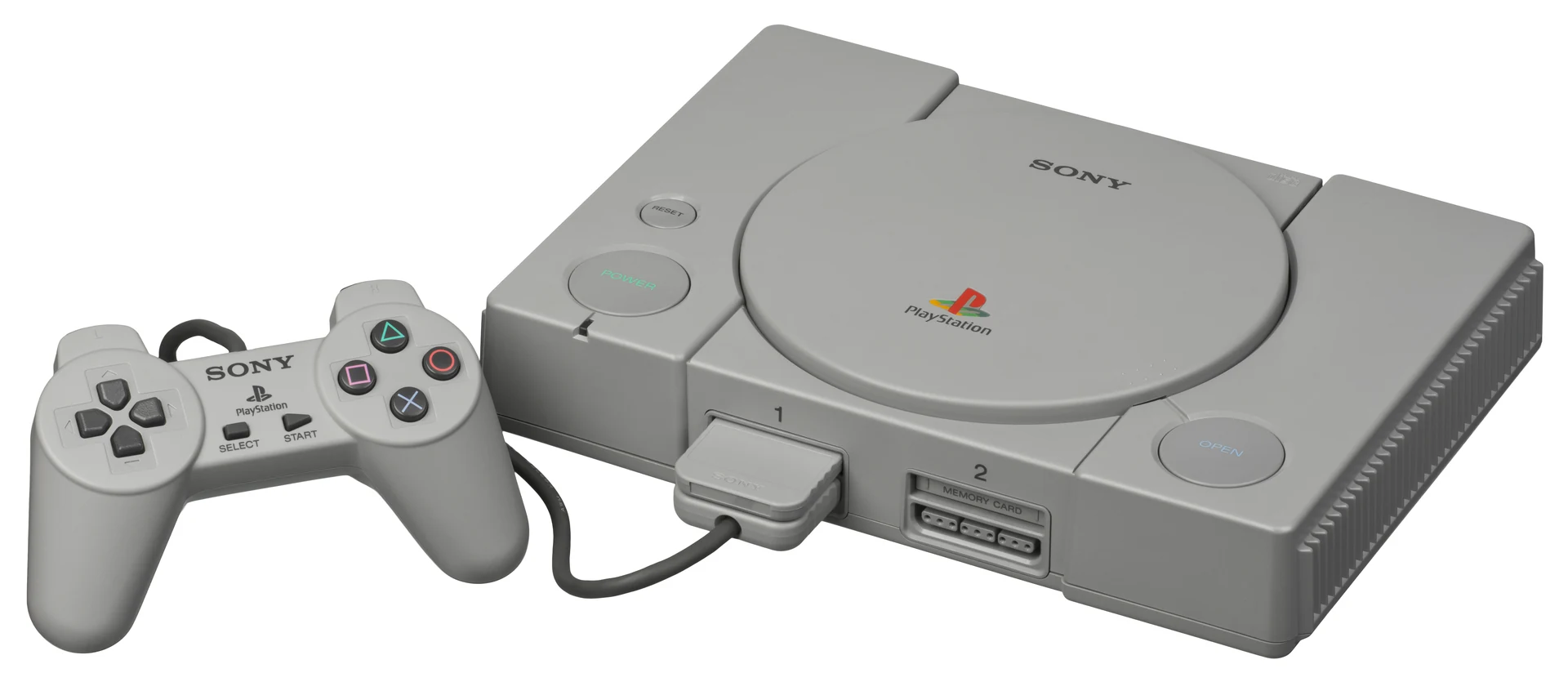
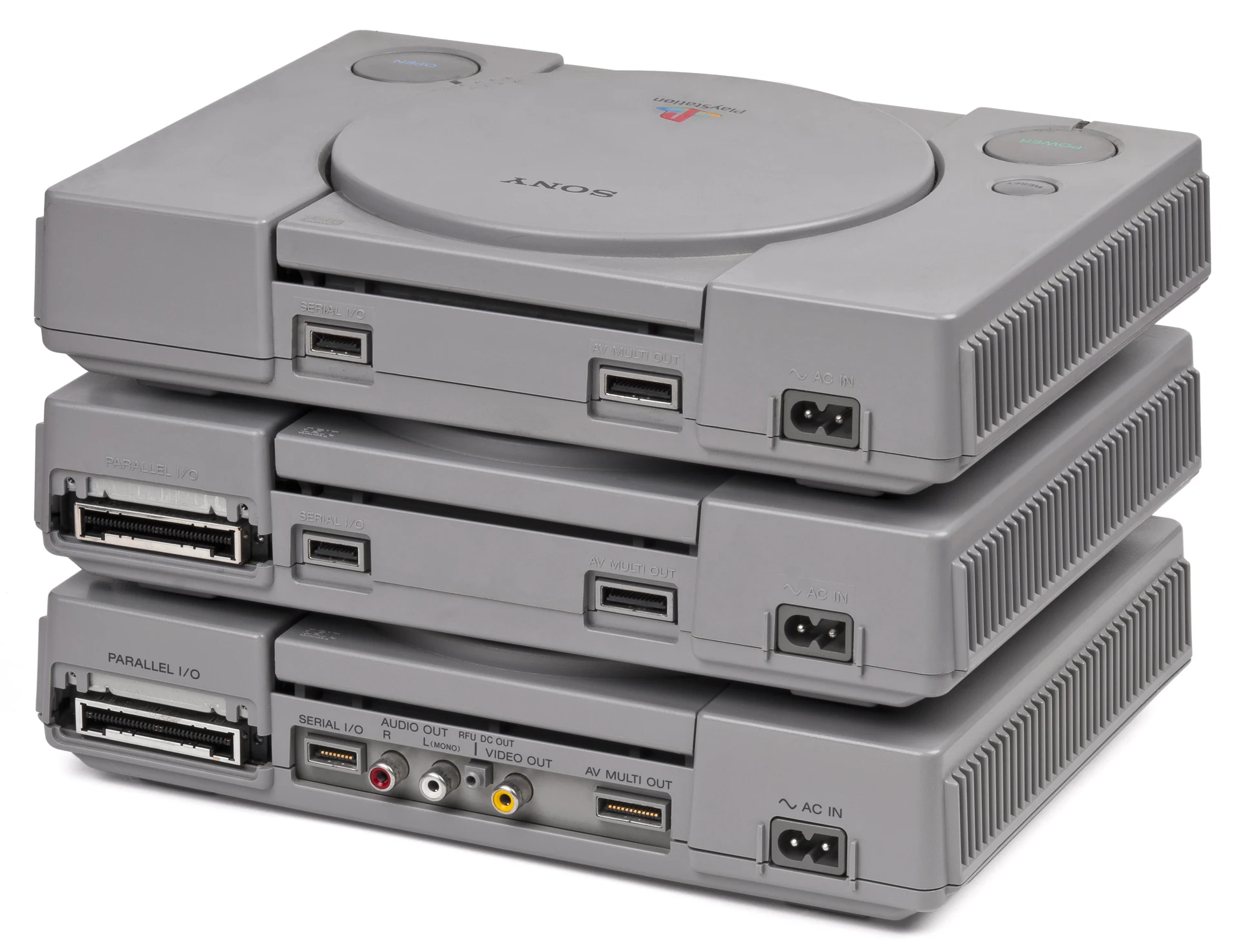
Pale-grey plastic. A wide circular disc lid. Two large physical buttons. Controller ports and memory-card slots facing forward. The shapes were simple enough that the machine could sit beside a VCR, stereo or CD player and look as though it belonged to the same world of serious consumer electronics.
That mattered.
Nintendo and Sega already had powerful identities in the home console market. Sony arrived from a different direction: televisions, stereos, music, electronics. The PlayStation did not need bright colours or a toy-like shell to announce itself. Its design could almost disappear into the equipment beneath the television.
For a child or teenager, that gave the machine an unusual authority. It was obviously for games, but it looked like equipment from the next room of life — the adult world of remotes, hi-fi components and expensive black or grey boxes with small lights on the front.
The disc format reinforced that feeling. Games were no longer necessarily solid cartridges pushed firmly into a slot. They were thin, reflective CD-ROMs stored in jewel cases, handled by their edges and vulnerable to fingerprints and scratches. A game could sit on a shelf beside music CDs. Its manual lived behind a plastic cover. Its artwork could use photography, pre-rendered imagery and typography that felt closer to magazines and club culture than to the toy aisle.
Historically, Sony launched the PlayStation in Japan on 3 December 1994, followed by North America on 9 September 1995 and Europe on 29 September 1995. Sony's own history describes the machine around a 32-bit R3000 CPU, CD-ROM media and the shift toward real-time 3D worlds. Those specifications explain what the machine could do.
They do not fully explain what it felt like to meet one.
The ritual
Open. Place. Close. Press. Listen.
The startup ritual was short enough to become automatic.
That is exactly why it lasted in memory.
Press the open button. Lift the lid. Remove the old disc. Hold the next one carefully by its edge. Press it onto the spindle. Close the lid. Make sure the controller is connected. Look at the memory-card slot. Press power.
None of this felt ceremonial at the time. It was simply how the console worked.
But repeated physical actions become a kind of private interface. Decades later, someone may struggle to remember the layout of a game's pause menu but immediately remember the feel of opening the PlayStation lid, the small resistance of the buttons, or the awkward reach toward the console from the carpet.
Even the disc created tiny rules.
Do not touch the underside. Put it back in the right case. Do not leave it face-down. If a game began behaving strangely, inspect it for scratches. Sometimes wipe it carefully on a shirt despite knowing that probably was not the official recommendation. A reflective surface became the container for an entire world, and its vulnerability made that world feel strangely physical.
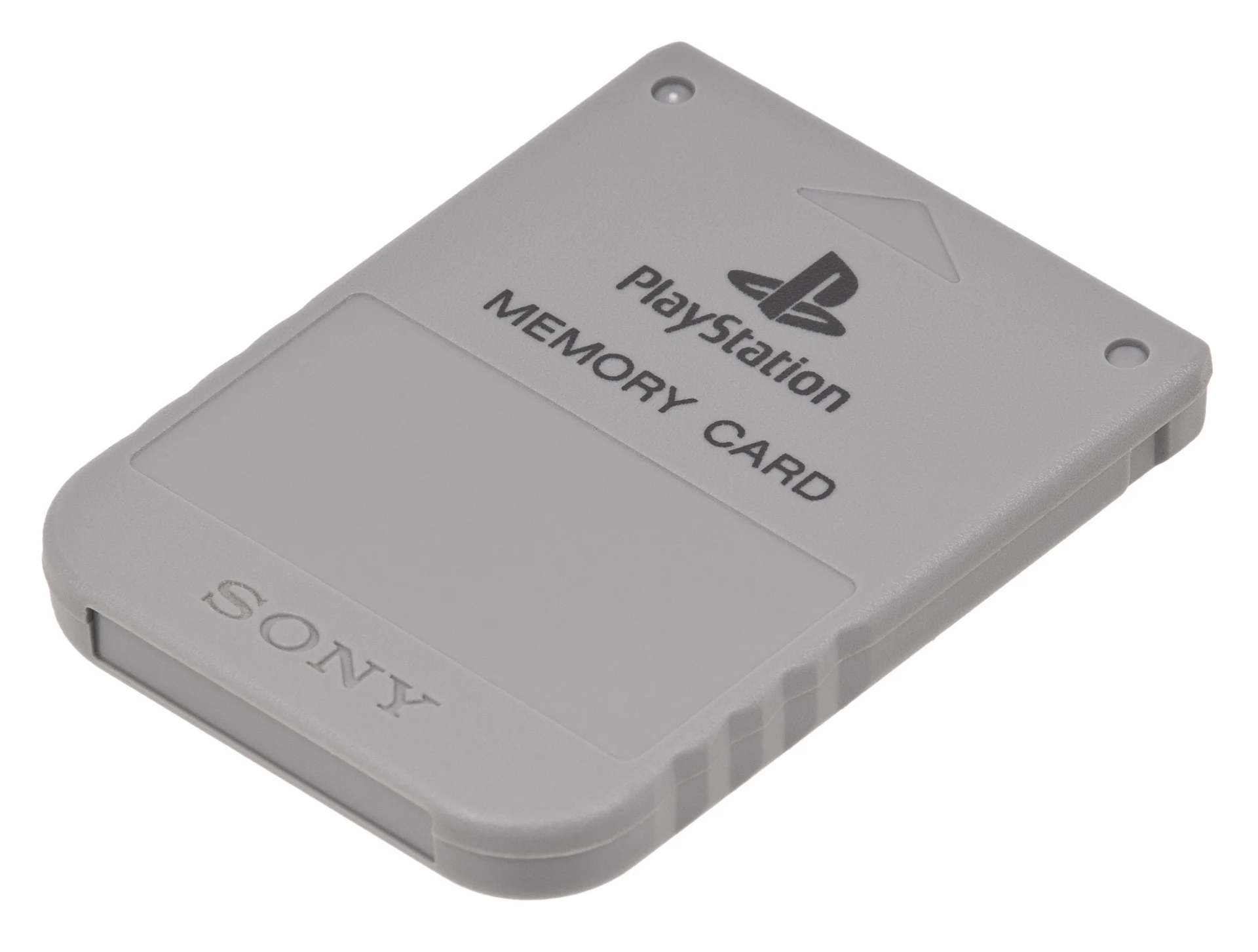
Then there was the memory card.
Save data was not an invisible service. It had a location. Sony's documentation for the original PlayStation-format memory card specifies fifteen memory blocks, approximately 120 KB in total. Games could occupy one block or several. Space therefore became something players could actually run out of.
That created its own small economy. Which save could be deleted? Was an old completed game still worth keeping? Did somebody else in the house have files on the same card? Was there another card somewhere in a drawer?
Progress was digital, but ownership was tactile.
A memory card could be labelled. Carried to a friend's house. Left behind. Put in the other slot. Lent out with a game. Lost behind a cabinet. The object itself became part of the biography of playing.
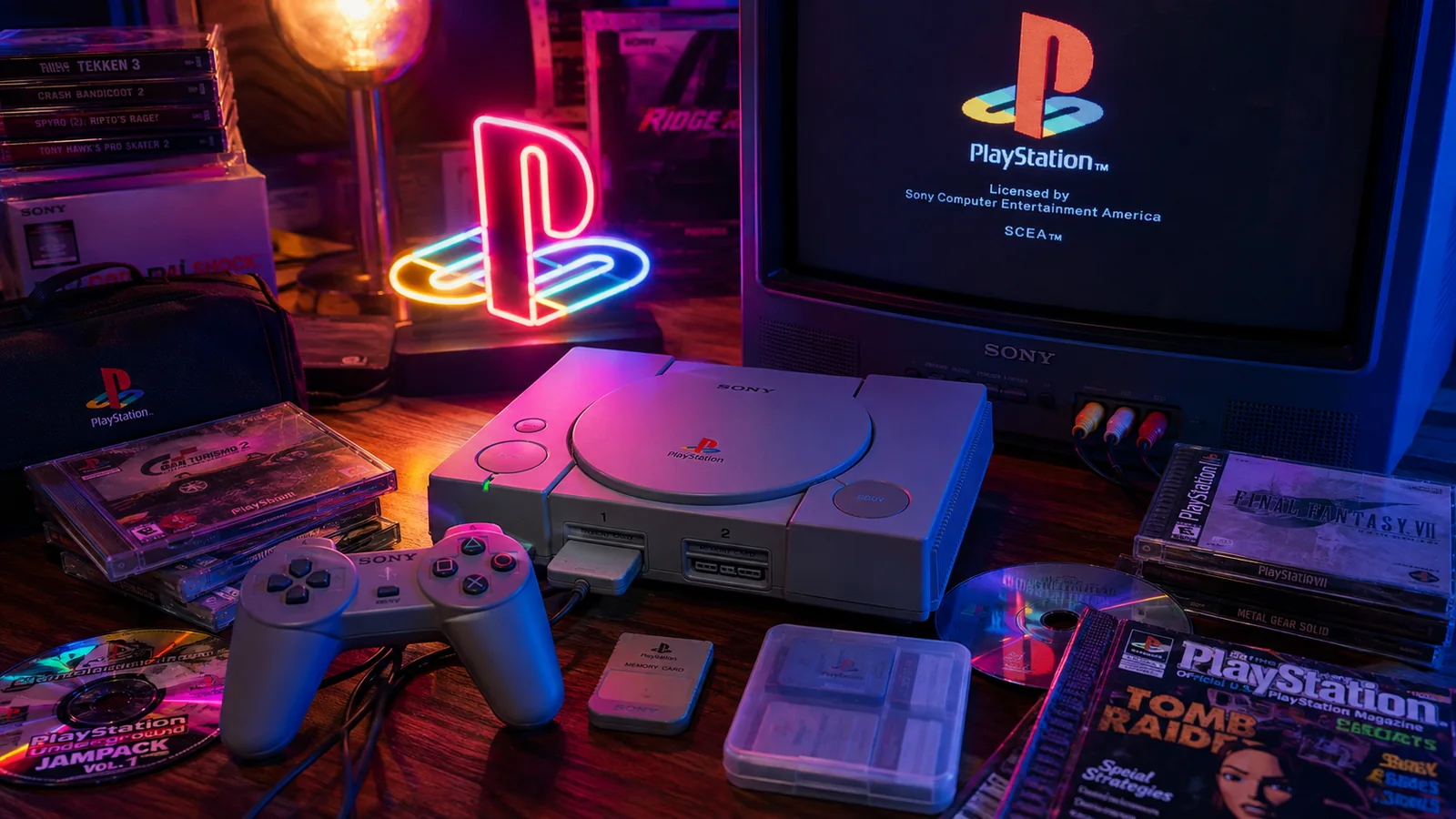
The room is the subject here: light, waiting, cables and the occupied space around the machine.
Things you probably forgot
Small constraints that stayed in memory
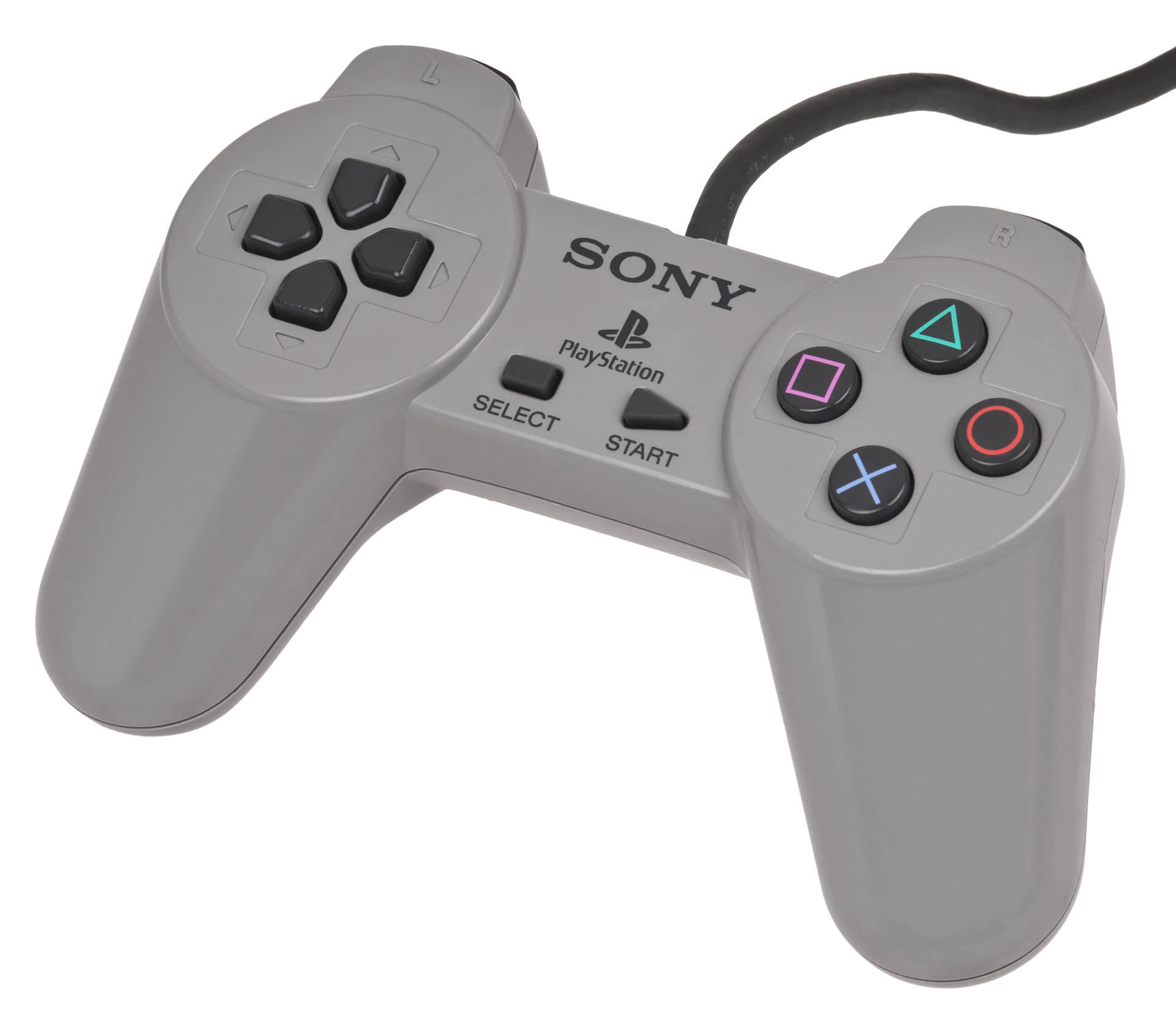
- The original controller had no analogue sticks. The familiar twin-stick PlayStation silhouette came later in the generation.
- The television occupied real physical space. A CRT was deep, heavy and visually present even when switched off.
- Controller cables designed the room. They determined how close people sat and which path across the floor everyone had to step over.
- Save space was visible. Fifteen blocks made progress feel finite in a way modern cloud storage rarely does.
- A game case mattered almost as much as the disc. Manuals, cover art and jewel-case shelves formed part of the room.
- The startup sequence carried information. The sound was not just branding; it helped signal that the hardware and disc-reading process were working.
The room around the memory
The console was only one object in the scene
A PlayStation memory rarely begins with the PlayStation alone.
It brings back the furniture.
The television cabinet. The VCR on another shelf. A remote with a loose battery cover. Jewel cases stacked horizontally because there was no proper place left to put them. A magazine open to a preview or cheat page. A school bag against a chair. Curtains turned into a dark reflective surface once evening arrived.
The CRT changed the atmosphere of play.
A modern flat panel can become a quiet black rectangle. A CRT had depth, curved glass, weight and a faint electronic presence. Bright menus lit the faces nearest the screen. Dark scenes turned the room itself into part of the image. When a loading screen flashed white or a game changed abruptly from darkness to colour, the light in front of the television changed with it.
The controller cable made that room measurable.
Sit too far away and the cable tightened. Move around someone and it caught a leg. Get up too quickly and there was always the possibility of pulling something you absolutely did not want to pull. If two people were playing, the geometry became more complicated. If several people were watching, the player with the controller occupied the privileged position closest to the line running back to the console.
So even single-player games were often socially experienced.
Someone watched from the sofa. A sibling waited for a turn. A friend knew how to get past a section you had been stuck on. A parent crossed through the room and asked when the television would be free again.
The software did not know any of this.
But the memory does.
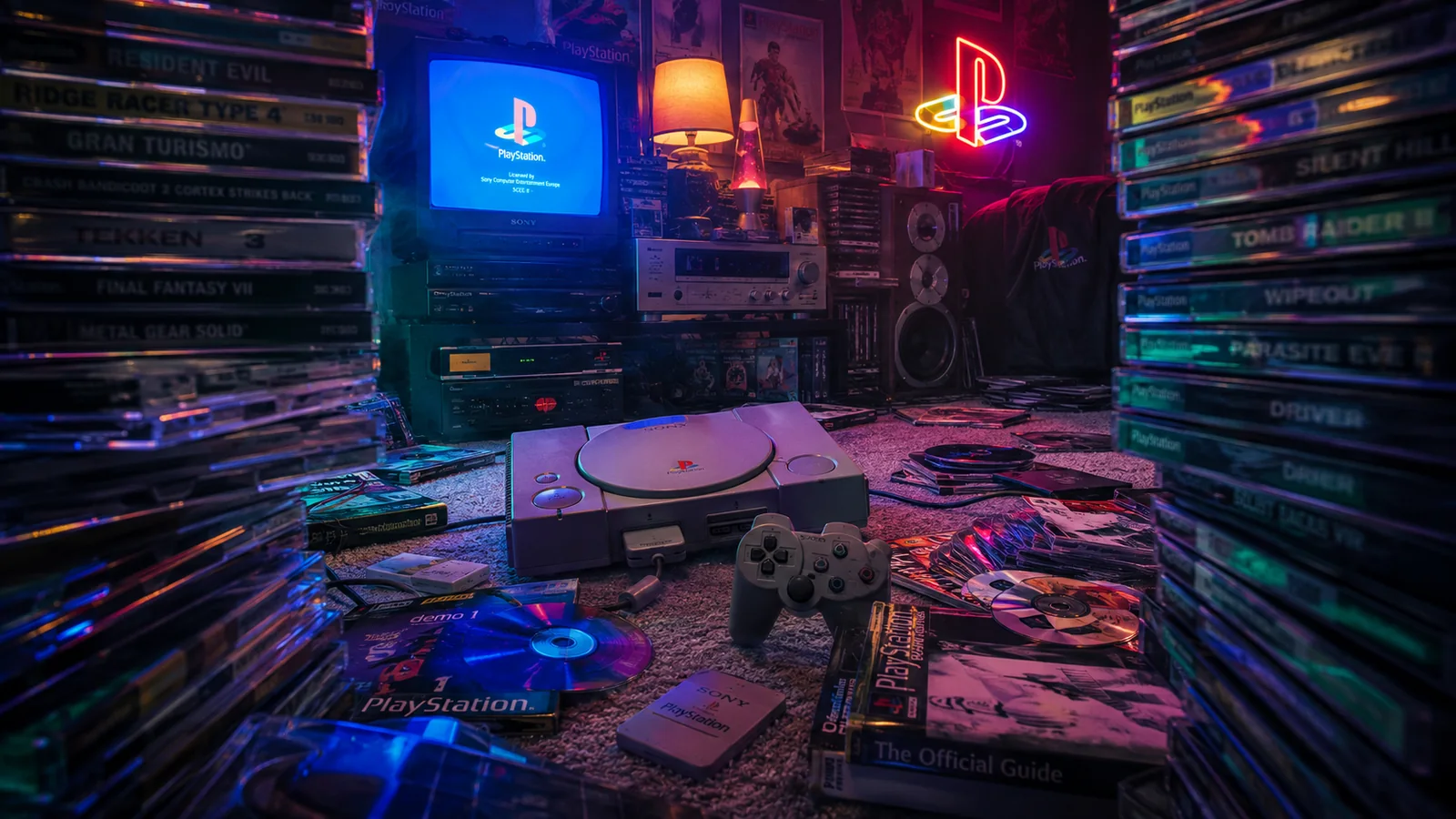
Spatial memory has a different truth: shelves, screen light and the feeling of being inside the room.
Archive window · the real world
What the hardware actually looked like
For historical accuracy, NMA-001 uses documentary hardware photography separately from its atmospheric reconstructions.
The factual visual anchor is an original PlayStation SCPH-1000 photographed with its controller. Additional archive images document the original controller, memory card and rear hardware layouts. These images are used to verify shape, scale, ports and physical relationships.
The atmospheric images have a different job: reconstruct the room, light, texture and anticipation around the object.
Those two visual functions should never be confused. A nostalgic image becomes less useful, not more useful, when the central hardware is wrong.
Watch the memory
Four windows back into the period

Open the box again
Unboxing the Original PlayStation — PlayStation
A useful hardware reference because the object, packaging and physical presentation are the subject rather than a modern recreation of the era.
Watch on YouTube ↗
How PlayStation spoke in 1995
Society Against PlayStation (SAPS) — 1995
A piece of period advertising that shows how quickly PlayStation separated itself from straightforward toy marketing.
Watch on YouTube ↗
The newcomer becomes a platform
PlayStation Evolution: The Beginning — PlayStation
A retrospective view of the original machine and the position it came to occupy.
Watch on YouTube ↗
The brand becomes a culture
Double Life — 1998
By the end of the decade, PlayStation advertising was no longer simply selling technical capability. It was selling the idea that gaming had become part of a person’s identity.
Watch on YouTube ↗Video players load only after an explicit click and use YouTube’s privacy-enhanced domain.
The sound of the memory
The startup sequence was part ceremony, part diagnostic signal
The startup sound deserves its own place in the archive because it was designed to do more than create a logo moment.
Takafumi Fujisawa created the original PlayStation startup sound in spring 1994 while the hardware was still being developed. He later explained that the sound had to remain recognisable across many different television speakers, and that ROM size imposed practical limits on what could be stored.
Those constraints pushed the sequence toward economy.
It begins quietly. It establishes stability. Then it opens into something wider and less predictable. Fujisawa described wanting to move the listener from security toward excitement and compared the intended feeling with entering a cinema.
The most revealing detail is functional.
According to Fujisawa, the sound told the user that the hardware was running correctly and that the disc had been read successfully. The reverse-swoosh element was designed so that it could loop if the disc-reading process failed.
That changes how the sound should be remembered.
It was not merely branding that nostalgia later elevated into something important. It was embedded in the act of starting the machine. Players listened because the sound meant the process was moving forward.
The atmosphere and the diagnosis were the same event.
Why this felt different
Different constraints produced different behaviour
Modern game systems remove enormous amounts of friction.
Games can be bought without leaving the sofa. Saves can synchronise automatically. Controllers are wireless. Updates arrive over the internet. Friends can join from another city. Entire libraries can exist without a single case on a shelf.
Most of that is objectively more convenient.
The first PlayStation belonged to a different behavioural structure.
Software arrived on discs. Save capacity was scarce and removable. Controllers were tethered. Information came through shops, magazines, television, friends and demo discs. A new game could occupy attention for weeks because access to alternatives was narrower and buying another one was a meaningful event.
That does not mean every old limitation was secretly good.
Scratched discs were frustrating. Limited memory-card space was frustrating. Cables were inconvenient. Games were expensive. A household could have one television and several people wanting to use it.
The point is not that friction should be romanticised.
The point is that friction creates repeated actions, and repeated actions become memory.
When technology removes an action, it often removes the ritual attached to it as well.
There is no need to check whether a cloud save is physically in the slot. No need to carry progress in your pocket. No need to walk across the room to change a disc if the next game is already installed. No cable determines where the player must sit.
The experience improves.
The shape of the memory changes.
Cultural context
A newcomer that did not behave like one
When PlayStation entered the market, Nintendo and Sega were already established names in console culture. Sony was famous, but not for having a long history of home game consoles.
That outsider position became part of the opportunity.
The machine's CD-ROM format, real-time 3D emphasis and visual identity helped it arrive as something adjacent to existing game culture rather than merely the next step inside it. Sony's current historical timeline records more than 102 million original PlayStation consoles sold worldwide between 1994 and 2006.
At that scale, product details stop being private details.
The grey shell becomes recognisable across countries. The four controller symbols become a language. The startup sound becomes collective memory. The memory-card slots become part of how a generation understood saved progress.
The controller itself also changed during the life of the platform. The earliest PlayStation experience was built around a digital controller without analogue sticks. Later controllers introduced analogue input and vibration, eventually creating the twin-stick layout that became inseparable from PlayStation's visual identity.
So even “the PlayStation controller” is not one frozen object.
The platform changed while people were growing up with it.
Contemporary evidence
The future was marketed as attitude
One reason the PlayStation felt different is visible in the advertising around it.
The hardware itself was quiet: grey, compact, restrained.
The brand language was not.
PlayStation's own archive preserves campaigns such as Society Against PlayStation from 1995 and Double Life from 1998. They show how quickly the platform moved beyond straightforward demonstrations of graphics or games.
The message became cultural.
By the end of the 1990s, PlayStation advertising could frame playing as something people carried alongside their ordinary lives: an identity, a parallel world, a private intensity hidden inside everyday behaviour.
That contrast helps explain the console's particular version of “the future.”
It was not chrome walls and science-fiction props.
It was a sober grey object beneath an ordinary television, surrounded by marketing that implied the person using it had just entered a new culture.
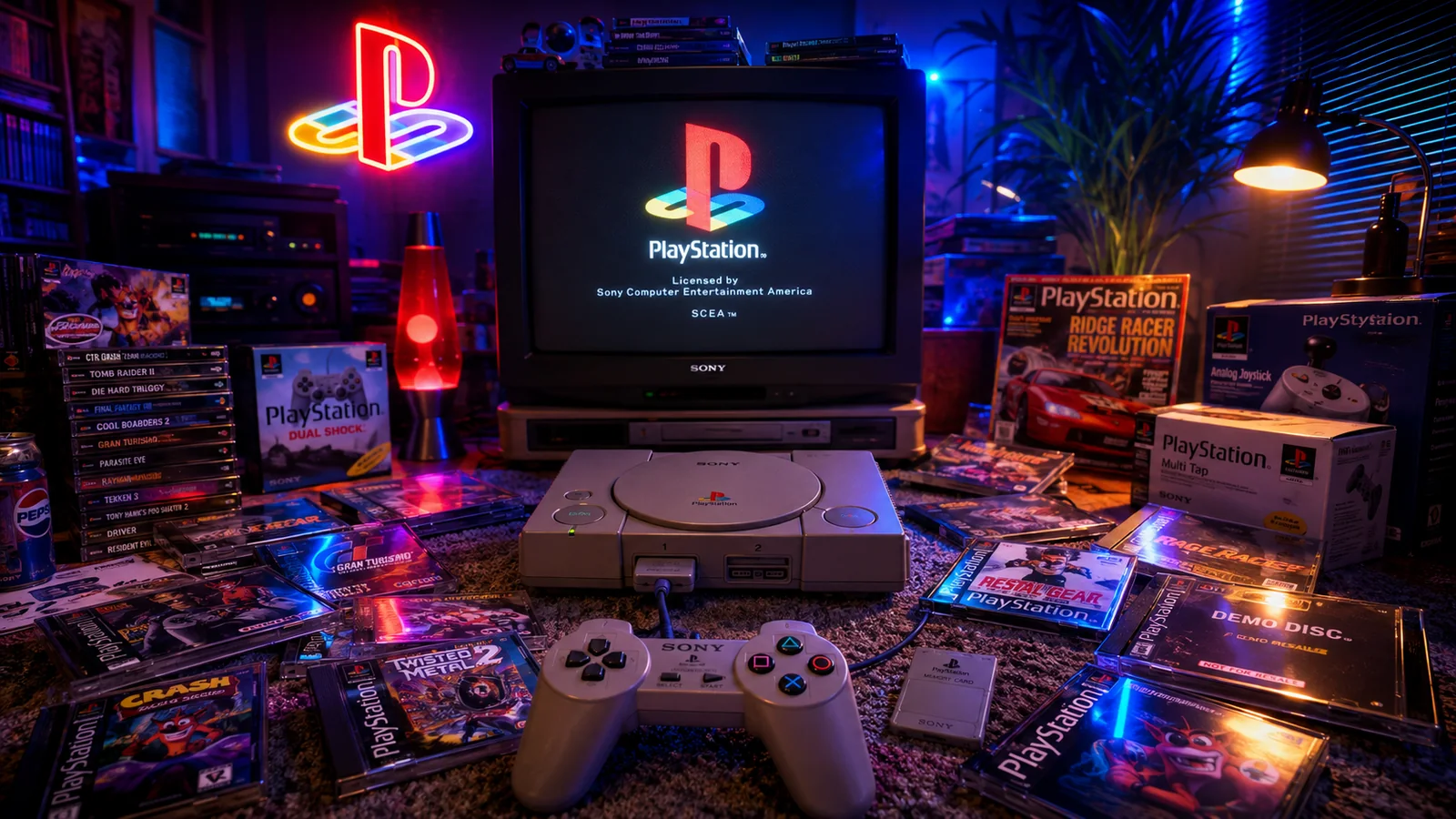
A late-page return to the room: glow, clutter and the quiet expectation before the game begins.
The small detail that brings it back
Hands and history occupied neighbouring ports
Look at the front of the original console.
The controller plugs in below.
The memory card plugs in above.
Hands and history occupy neighbouring ports.
That arrangement is so ordinary that it is easy to overlook, but it compresses the entire PlayStation ritual into a few centimetres of plastic. One connection is what you do now. The other is what you are allowed to keep.
Modern systems hide that relationship almost completely.
On the first PlayStation, it was visible every time you sat down to play.
a game was an object, progress was a removable object, the controller was physically attached to the console, and the television defined the room.
games can be services or downloads, progress is usually infrastructure, controllers are wireless, and the screen is only one node in a wider account-based system.
The modern version is smoother. The older version left more fingerprints.
Memory prompt
Where did your first PlayStation actually sit?
Where did your first PlayStation actually sit?
Not which model you owned or which game you liked best.
Think about the room.
Was it on the floor, in a television cabinet or balanced beside a VCR? Where were the jewel cases? Did your memory card have a label? Who sat closest to the screen? Which cable always got in the way? Which game made everyone else in the room stop and watch?
Those small domestic details are where the memory becomes specific again.
Sources & archive note
Evidence behind the memory
Historical claims in this Memory File are grounded primarily in Sony / PlayStation's official history material and PlayStation's published interview with startup-sound designer Takafumi Fujisawa. Original hardware photography is sourced separately in the NMA-001 source register. Reconstruction imagery and documentary evidence remain explicitly distinct.
Last editorial verification: 20 August 2026