
Memory File NMA-006 · 1989–2001
Playing Game Boy Under the Covers
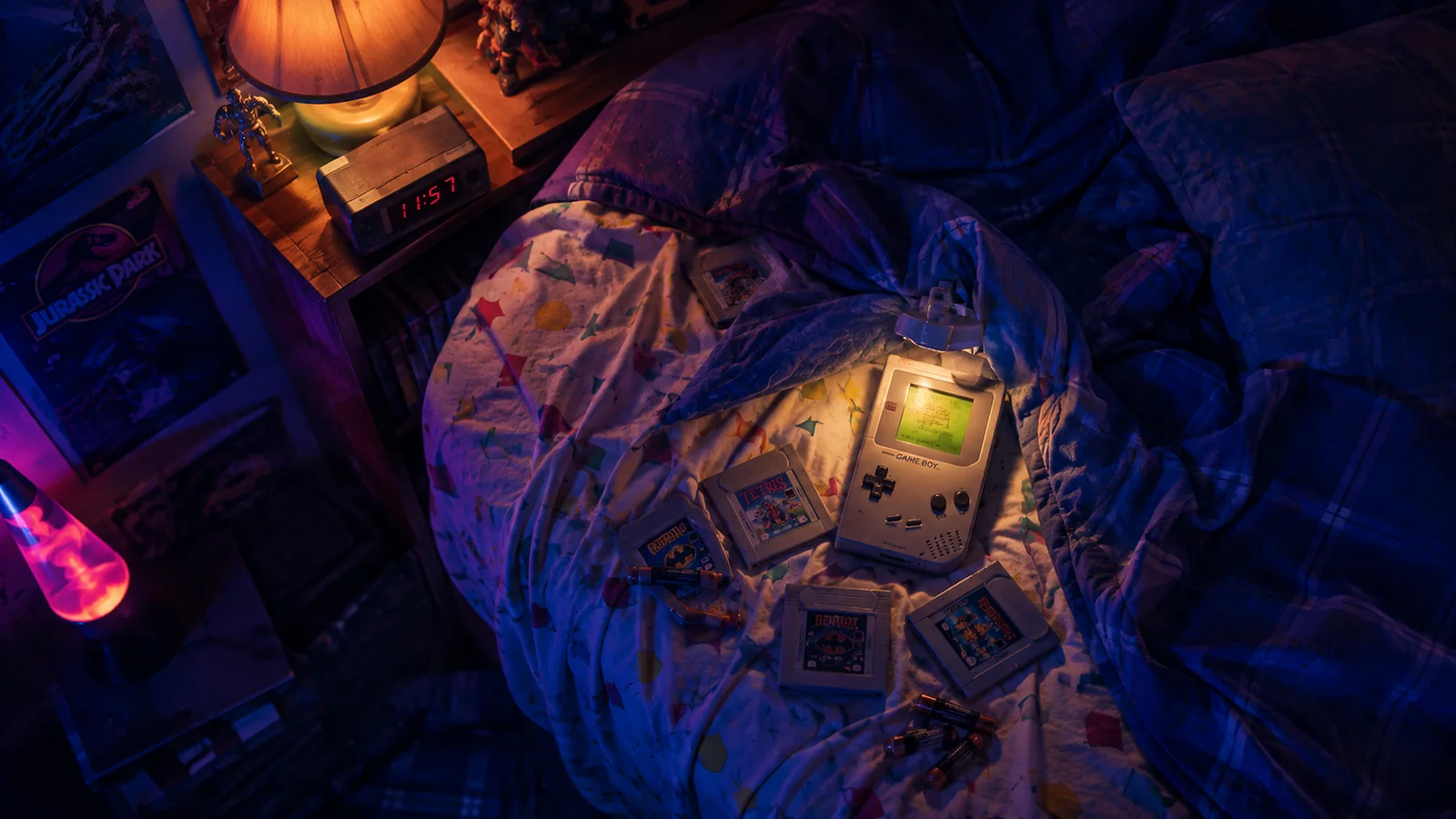
A dim green screen beneath the blanket created a private world hidden inside the night.
Atmospheric reconstruction · Original NMA editorial artwork
The room was supposed to be dark. Under the covers, a small grey machine continued the day in secret, its green screen visible only at the correct angle.
Portable did not mean effortless
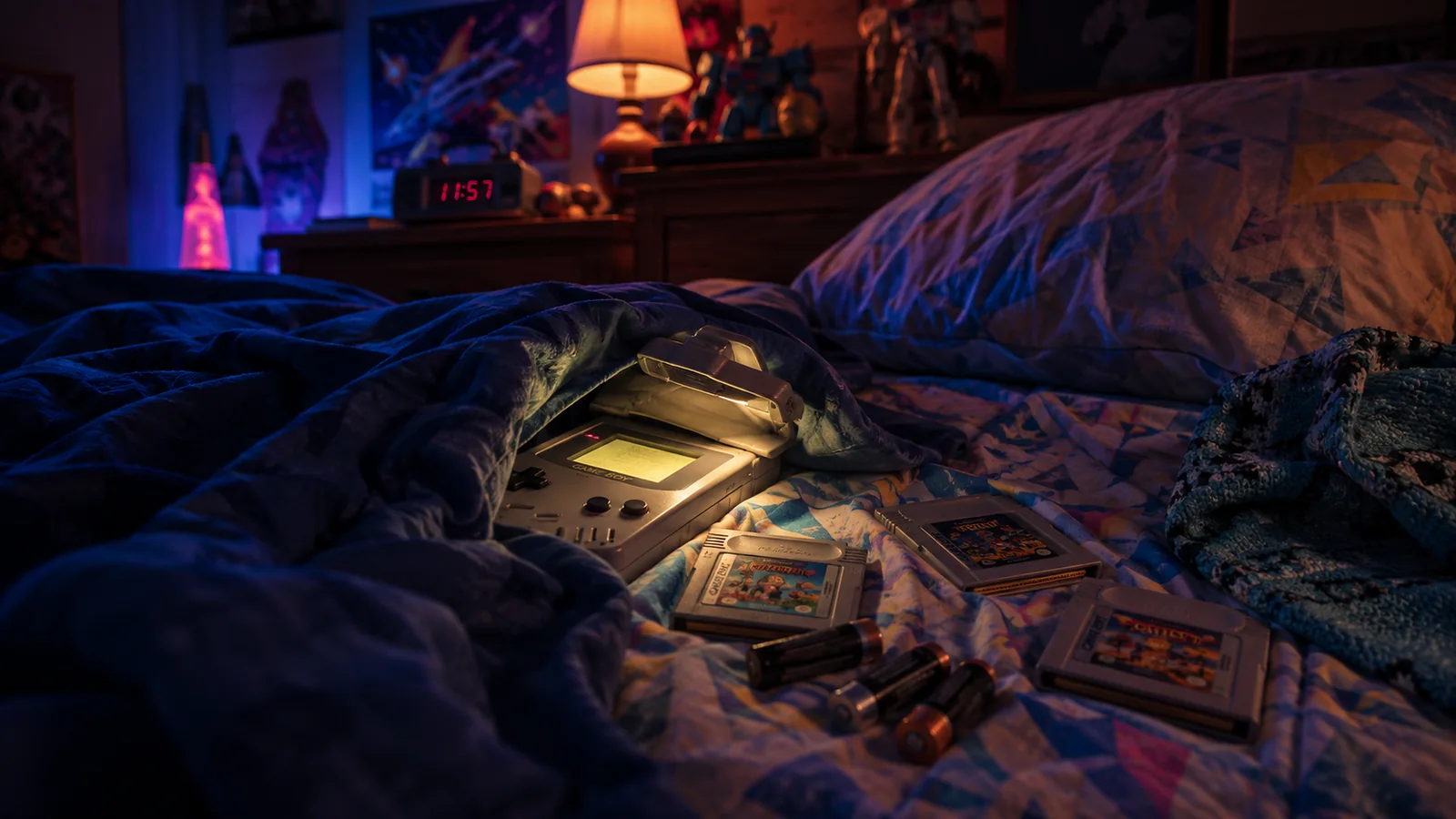
The original Nintendo Game Boy required light, batteries and patience. Contrast had to be adjusted and every viewing angle negotiated. Those limitations created physical rituals that modern backlit devices have erased.
A world hidden inside fabric
Sound stayed low, buttons were pressed carefully and every movement outside the room became a threat. The secrecy amplified simple games. A level completed after bedtime felt more valuable because it existed outside the permitted schedule.
The green afterimage
A few cartridges accompanied holidays and car journeys. Their worlds were completed by imagination rather than detail. The Game Boy remains in memory as a quality of light: olive pixels floating in darkness, small enough to be completely ours.
The wisdom of the grey brick
The original Game Boy looked practical before it looked futuristic. Its case was a warm grey rectangle with rounded corners. The directional pad sat beneath the left hand. Two action buttons, coloured a muted reddish purple, rested beneath the right. Start and Select were narrow rubber shapes placed between them. Nothing needed explanation for long. The controls inherited a language Nintendo had already taught through its home console. A cartridge entered the top. A wheel adjusted volume. Another changed the screen contrast. Four AA batteries disappeared behind a panel on the back. Inside, the machine represented a philosophy often associated with Gunpei Yokoi: lateral thinking with mature, or “withered”, technology. The phrase is sometimes misunderstood as a celebration of weak hardware. It was closer to a discipline. Technology that had become inexpensive, reliable and well understood could be recombined in a new way. The objective was not to win a list of specifications. It was to make a useful play experience that could survive manufacturing, ownership and time. The Game Boy’s competitors could display colour and, in some cases, illuminate their own screens. On a shop counter, those abilities were persuasive. Nintendo chose a reflective monochrome display and less demanding hardware. The trade was visible every time the machine was switched on. So was the benefit. The Game Boy could run for far longer on one set of batteries than the most power-hungry colour handhelds generally managed. Exact battery life varied with the cells, volume, game and age of the machine, so remembered numbers should not be treated as laboratory constants. The practical difference was nevertheless large enough to shape use. A portable console that exhausts its batteries quickly is portable only while its supply lasts. The Game Boy’s endurance allowed it to become dependable. It could be placed in a bag without a precise plan. It could survive several sessions separated by days. Parents buying batteries encountered the cost less often. A journey did not need to end when the first landscape outside became dark. The case reinforced the same idea. It was not delicate. The body felt dense, the cartridge clicked into place and the controls were protected by the machine’s simple outline. Game Boys were still damaged, lost, corroded and broken, but their reputation for durability grew from ordinary years of being handled by children. The famous grey brick was a compromise made visible. Its size, screen and weight belonged to the technology Nintendo was willing to trust. In exchange, the machine behaved less like a miniature luxury device and more like a tool. It was something to use. And because it could be used almost anywhere, its modesty became a form of freedom.
Four shades and borrowed light
The screen did not glow. It waited for the world around it. Daylight, a lamp or the passing light of a car had to strike the reflective display and return through the image. Too little light and the scene collapsed into darkness. Too much glare and the surface became a mirror. Playing involved continual small adjustments. Tilt the machine. Turn towards the window. Move a thumb away from the light. Change the contrast wheel until the background and sprites separated without becoming heavy shadows. This inconvenience became one of the most physical memories of the system. The original display measured 160 by 144 pixels and could present four shades. It was often described casually as black and white, but its appearance depended on the liquid-crystal panel, surrounding light and ageing. Many remember a greenish background with dark olive forms; others remember grey, yellow or the softened tint of a particular machine. Movement could leave a trace. The response characteristics of the early passive-matrix screen caused fast objects to blur or ghost. Developers learned to work within the display. Large silhouettes, strong contrast and tile-based forms remained readable when finer movement might dissolve. The limitation influenced art. A face could not rely on colour to separate itself from a background. A landscape could not use a distant blue mountain and a green foreground. Designers organised images through value, pattern, outline and motion. Four shades became four functions. The palest value opened space. The darkest anchored edges. Middle tones described texture, depth or damage. Dithered patterns placed light and dark pixels beside one another so the eye read an additional surface the hardware did not literally contain. Artists could also use absence. An empty background was not unfinished if it allowed a tiny moving character to remain legible. A cave could feel deep because its darkness consumed detail. A bright sky could make a handful of dark tiles appear like a distant, exposed structure. The screen demanded economy, but economy is not the same as simplicity. Within 160 by 144 pixels, designers built maps, menus, portraits, scrolling landscapes and battles. They used reusable eight-by-eight tile patterns as the foundation of backgrounds and objects, arranging a limited vocabulary into places that felt distinct. The player met the image halfway. Looking closely made individual pixels disappear into meaning. The screen occupied only a small part of the visual field, but concentration enlarged it. A bedroom remained around the hands, yet attention narrowed until the border of the display became the edge of the known world. The borrowed light made that border fragile. A cloud outside could dim the landscape. A blanket used for secrecy could also make the game impossible to see. Clip-on lamps and magnifiers tried to solve the problem, often turning a compact machine into an elaborate insect of plastic arms, bulbs and batteries. Years later, modders would fit clearer illuminated displays into original Game Boys. The transformation makes old games easier to see and can be beautiful. It also reveals what the original experience asked from the body. The old screen did not present itself from across a room. It made you find the light, hold it close and enter deliberately.
A world assembled from tiles
Behind the screen, the Game Boy organised much of its visual world as small reusable pieces. Backgrounds were built from eight-by-eight pixel tiles. A game could store patterns for ground, walls, letters, faces and decoration, then arrange references to those patterns across a map. Moving objects used related small forms, with strict limits on how many sprites could appear across one horizontal line. The method saved memory. It also gave Game Boy worlds a recognisable visual rhythm. A brick repeated because it was literally the same small image called again. Grass grew from a limited set of patterns. Trees, doors and clouds were assembled from modular parts. The machine did not carry a complete picture of every location; it carried a language from which locations could be constructed. Skilled artists made repetition feel intentional. They varied outlines, interrupted patterns and used negative space to prevent a map becoming visual noise. They knew that a player needed to identify hazards while the entire scene moved across a display prone to ghosting. The same economy shaped animation. A character might have only a few frames for walking, jumping or turning. A one-pixel change could transform posture. A dark cluster at the front of a sprite became a face because it remained consistently attached to the body and reacted at the correct moment. Scale became expressive. Some heroes were tiny, leaving room for a level to unfold around them. Others filled more of the display, making combat or personality easier to read. Role-playing games sometimes replaced free movement with portraits, text boxes and battle screens, allowing the imagination to construct a world across several different visual modes. Cartridges expanded what the base machine could become. Memory controllers, saved data and later special components allowed developers to build games far beyond the scale of the earliest releases. The hardware did not change each time, but knowledge of it accumulated. Programmers learned timing tricks. Artists found more efficient tiles. Composers understood how to make four sound channels suggest a complete arrangement. This long familiarity mattered. The Game Boy and its colour successor remained active across an extraordinary span of design history. A cartridge from the end of that period could make the old architecture produce images and systems its launch library had not predicted. The world in the pocket grew without making the pocket larger. It grew through fluency. The limits stayed in place, and generations of developers became better at speaking through them.
Sources & evidence
Documentary record
Nintendo
Open source recordThe Strong National Museum of Play
Open source record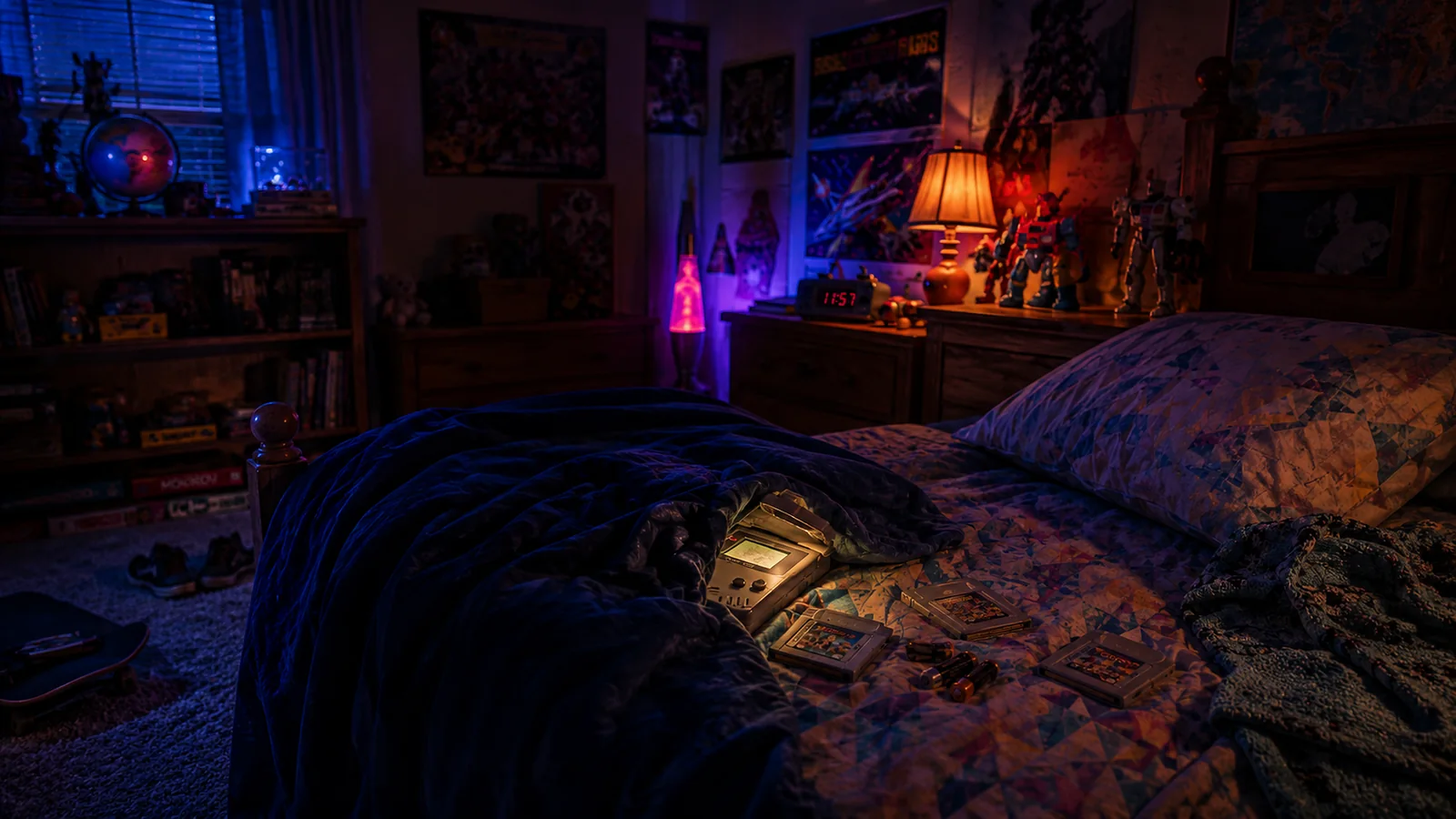
The sound beneath the noise
Switch on an original Game Boy and the first sound is not music. It is a small electronic acknowledgement. A logo descends. A clear tone confirms that the cartridge has passed the machine’s opening ritual. Then the game takes over, and the speaker begins translating an entire world through a grille only a few centimetres wide. The hardware offered four basic sound channels: two pulse channels, a programmable wave channel and a noise channel. From these, composers built melody, bass, percussion, wind, machinery and warning. The pulse waves gave many Game Boy themes their bright, exposed character. The wave channel could supply a softer or more unusual voice. Noise became drums, impacts, surf or the rough edge of motion. Every part competed for limited space. A chord might need to be implied through rapidly changing notes. A percussion hit could momentarily borrow attention from another layer. Silence became useful because it allowed the next tone to feel larger. Through the built-in speaker, the result mixed with life around it. Tyres on a road became part of the soundtrack. Adults talking in the front seat covered quiet notes. A train announcement interrupted a battle. The volume wheel was a negotiation between the private game and the public place containing it. Headphones changed the scale. The Game Boy could output stereo through its headphone jack even though the internal speaker was mono. With earphones attached, the small machine became an enclosed sound world. Simple electronic parts separated around the listener. The room remained visible but acoustically distant. This privacy was new for many children. The family television announced a game to everyone nearby. A handheld with headphones could disappear into one person. Its music did not need to compete for permission or become part of the household’s shared noise. The intimacy was not always solitary. A melody escaping from the speaker could identify a game to somebody across a room. Two players recognised the sound of a battle or a completed line. The machine’s limited voices became social signals precisely because they were so distinctive. Decades later, those tones can reconstruct a place with startling speed. Not because four channels produced a realistic soundscape, but because they repeated beside particular journeys, rooms and ages. The music attached itself to the conditions in which it was heard. The noise around the Game Boy became part of the Game Boy. And beneath that noise, a tiny speaker carried a world close enough to keep.
Time measured in batteries
Portable play had a second clock. It was not displayed on the screen. It lived inside four AA batteries. Every session consumed a little of their remaining charge. At first, the picture was firm and the speaker clear. Later, the image might fade, the audio weaken or the machine switch off at the wrong moment. The contrast wheel could temporarily recover visibility, but it could not create energy. Children learned to read these signs. A set of batteries became part of the journey’s preparation. Spares travelled loose in bags or waited in the kitchen drawer. Rechargeable cells promised another cycle but did not always begin with the same strength. In an emergency, batteries migrated from radios, toys and remote controls. This introduced a material cost to invisible progress. A saved quest depended on a cartridge battery designed for a different purpose, while the immediate act of playing depended on the cells in the machine. Electricity was not an abstract service arriving through a wall. It was four physical objects that could be counted, replaced and carried. The Game Boy’s comparatively long endurance softened that anxiety. It encouraged a different rhythm from handheld rivals whose colour or illuminated displays demanded more power. A player could forget the batteries for a while, which is one of the conditions required for a portable device to feel trustworthy. Trust changed where games were allowed to go. A parent did not need to calculate whether a short trip justified fresh cells. A child could switch the machine on for ten minutes, stop when the car arrived and return later without feeling that the opportunity had been wasted. The Game Boy adapted to fragments. Its games still included long adventures, but the hardware made short encounters natural. Complete one stage. Clear a few lines. Walk to the next town and save. The device could be interrupted by dinner, arrival or an adult asking a question. That flexibility made it part of everyday time rather than an event requiring the television. The batteries eventually failed. The important thing was how long the machine allowed the player to stop thinking about them first.
The library in the coat pocket
A Game Boy cartridge was smaller than the world it contained. The grey shell revealed almost nothing. A label offered a title, an image and perhaps a hint of colour the screen itself could not reproduce. Along the bottom, exposed contacts waited to meet the console. Insert the cartridge and the machine changed identity. It became a platforming journey through an unfamiliar kingdom. A pinball table. A tennis court. A submarine. A dream. Later, it could become a region filled with creatures, towns and routes whose relationships persisted for dozens of hours. This transformation made collecting physical. Games could be arranged in plastic cases, carried loose in pockets or stored in larger organisers whose vacant slots suggested future discoveries. Lending a cartridge meant surrendering the entire game to somebody else for a while. The object could carry personal time. Cartridges with battery-backed memory stored progress after power was removed. A saved file turned one identical grey shell into *your* version of the world. It held a name, an inventory, a location and evidence of decisions no label could show. That persistence increased intimacy. A high score could be surpassed. A platform stage could be replayed. A role-playing save seemed to wait. The world did not reset simply because the screen went dark; it continued as a possibility inside the cartridge. The technology was not permanent. Save batteries could eventually fail. Cartridges collected dust and corrosion. Cleaning rituals, sometimes sensible and sometimes inherited as playground folklore, became part of keeping the library alive. The games themselves varied enormously. Some were careful original works designed for the machine. Others were compromised conversions, rushed licences or repetitive experiences sold on a familiar name. A large library does not guarantee a consistently good one. But abundance mattered. It allowed the Game Boy to outlive its first identity. New owners met it through different games and later revisions. The smaller Game Boy Pocket, the Japan-only Game Boy Light and the Game Boy Color changed the body or display while maintaining a relationship with much of what came before. The library made the hardware continuous. A machine received for one game could become a companion for years because the next world did not require replacing the entire object. Only the small grey door at the top needed to open again.
A world that travelled between children
By the middle of the nineteen-nineties, the original Game Boy was no longer a new machine. Its monochrome screen belonged to an earlier technical moment. Colour handhelds had appeared. Home consoles were entering real-time three-dimensional worlds. The grey brick could reasonably have begun a quiet decline. Instead, Pokémon gave its limitations a new purpose. The first games were released in Japan in 1996, followed later by international versions. Their world was graphically modest even by the standards of the system. Towns were built from repeated tiles. Creatures appeared as small monochrome images. Battles relied on menus, text and imagination more than animation. But the central idea was larger than the display. The player collected creatures inside a personal cartridge. They were not merely entries unlocked on a common list. They had levels, moves and a history of time spent together. The saved game transformed the cartridge into a private habitat. No single version contained every creature available in the wider design. Completion therefore required another person. Through the link cable, a creature could be traded rather than copied in the fiction of play. Something left one collection and entered another. The exchange gave digital information the emotional structure of a physical possession. Satoshi Tajiri and the team at Game Freak recognised possibilities in the cable that extended beyond direct competition. Accounts of the game’s conception connect it to childhood insect collecting and to the desire to transfer valued things between players. The result made the Game Boy social without making it impersonal. Each child still held a separate screen. Each journey contained different decisions and encounters. Connection happened because the private worlds were different, not because they were merged into one public space. Playgrounds became networks. Rumours travelled alongside trades. Children discussed where a creature had appeared, whether a hidden event was real and what might happen under an unlikely sequence of actions. Much of this information was inaccurate. That did not make the culture around it insignificant. The small screen protected mystery. There was no permanent online guide waiting inside the machine. A rumour could survive because the cartridge remained partially unknown, and because another child’s confident account was sometimes the only available map. Pokémon did not single-handedly explain the Game Boy’s longevity, and its global success depended on animation, cards, marketing and a much larger media system. But the games revealed what Nintendo’s old hardware could still do. It could hold a world close enough to feel owned, then open a narrow door through which part of that world could be given away.
The smallest room in the house
Portability is often illustrated with movement. The Game Boy on a train. On an aeroplane. In a car crossing a country. But some of its most important journeys happened without travelling anywhere. A child carried it from the living room to the bedroom. That short distance altered who controlled the experience. The television might belong to family schedules. A Game Boy belonged wherever its owner could find enough light and a few uninterrupted minutes. It filled the gaps adults did not recognise as time for play. Waiting for an appointment. Sitting at the edge of a sibling’s activity. Waking earlier than everybody else on holiday. Listening to conversation that was not meant for children. The machine created a small room inside the larger one. This room was not invisible. Buttons clicked. Music escaped. A parent could ask for the system to be switched off. Schools created rules around handhelds, and siblings negotiated turns. Portability did not remove authority or conflict. It changed their scale. Closing the game required no argument over the shared television. The machine could be lowered, hidden or placed beneath a pillow. The interrupted world remained physically nearby. Playing after bedtime has become one of the standard memories attached to the Game Boy, though the original screen made the fantasy difficult. Without a lamp, there was no image. Children used hallway light, reading lights and specialised accessories, sometimes engineering a solution more elaborate than simply going to sleep. That effort reveals the value of the private space. The game was not only entertainment. It was a small claim on attention. For some, it relieved boredom. For others, it offered calm during illness, travel or an unfamiliar room. For many, it was simply one beloved toy among others. Nostalgia should not turn every session into a profound refuge. Yet the form made refuge possible. The hands created a boundary around the screen. Headphones could create another around the sound. Inside both, the player controlled a world that asked very little space from anyone else.
What progress cannot replace
The Game Boy was uncomfortable in ways nostalgia can soften. Its screen was difficult in poor light. Motion blurred. The body could tire small hands. Batteries cost money. Saved data could vanish. Link play demanded equipment and proximity. Many games were repetitive, compromised or simply bad. Later handhelds solved much of this. Screens gained colour, illumination, clarity and speed. Batteries became rechargeable. Wireless systems removed the cable. Modern phones placed vast libraries, communication and high-resolution displays into thinner devices already carried everywhere. The world in a pocket is no longer surprising. That makes the Game Boy’s world easier to misunderstand. Its intimacy did not come from inconvenience alone. A dark screen is not automatically more meaningful than a visible one. The machine mattered because its constraints, durability, controls and software formed a coherent object at a particular moment. It had a clear boundary. The cartridge contained the game. The controls did not disappear beneath the image. No notification arrived over the level. The machine was connected when a cable deliberately connected it, and otherwise it remained quiet. Modern devices can reproduce this focus, but they do not produce it automatically. The Game Boy’s single purpose made entry simple. Switch it on and the same world returned. The absence of other functions reduced the number of reasons to leave. Its physical character also recorded use. A polished directional pad, a faded label and a name written on the back turned mass-produced hardware into a biographical object. The machine aged beside its owner. Later repairs and screen modifications continue that relationship, though they may create an experience different from the historical one. Preservation therefore has several meanings. It can mean keeping original hardware operating. It can mean dumping and emulating software before cartridges fail. It can mean documenting development, manuals and memories. No single method preserves the smell of a case, the pressure of old buttons and the exact light of a particular journey. Those details survive unevenly in people. The Game Boy’s legacy is not that technology should stop improving. It is that technical ambition has more than one direction. Sometimes progress means making an image larger, brighter and more detailed. Sometimes it means making the whole experience small enough to follow a child out of the room.
Audiovisual archive
Watch the memory
We Opened an Original Nintendo Game Boy From 1989
A close physical look at original Game Boy hardware, packaging and material details that support the episode’s object memory.
Open on YouTube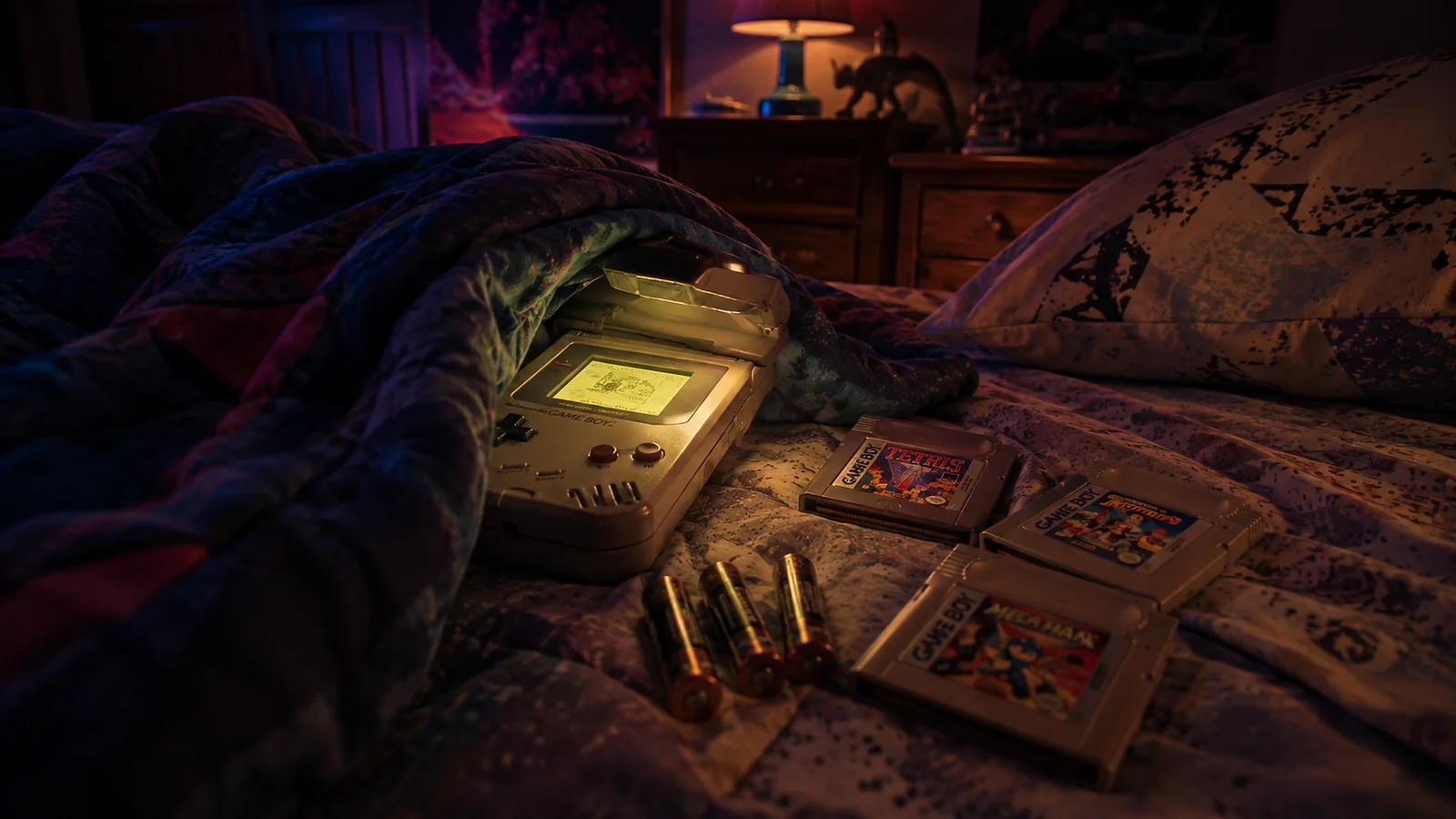
What remains
Outside the car window, another motorway lamp approaches.
The screen in your hands slowly returns.
First the border. Then the road. Then the tiny figure waiting exactly where darkness interrupted it.
The machine did not defeat the limits of its time.
It carried them.
Four shades. Four batteries. Four sound channels. A handful of buttons, a cartridge and a display that borrowed whatever light the world was willing to give.
From these modest parts came places that could travel.
They waited in coat pockets and school bags. They crossed a link cable into a friend’s hands. They opened in bedrooms, waiting rooms and the silent middle of long journeys.
The Game Boy made games smaller without making their memories small.
Perhaps it did the opposite.
By asking the player to hold the world close, it allowed the surrounding moment to attach itself forever: the rain on the window, the noise from the front seat, the weakening batteries and the next pool of light on the road.
The lamp passes overhead.
For a moment, everything is visible.
Then the landscape outside disappears, and the one in your pocket carries on.
---
Memory prompt
What detail do you remember?
Not the product alone—the room, the waiting, and the small rule that made the moment yours.
Archive note
This Memory File is open through the governed release registry. Reconstruction imagery is labelled separately from documentary references.