Memory File NMA-005 · 1987–2005
The Last Light Inside the Video Store
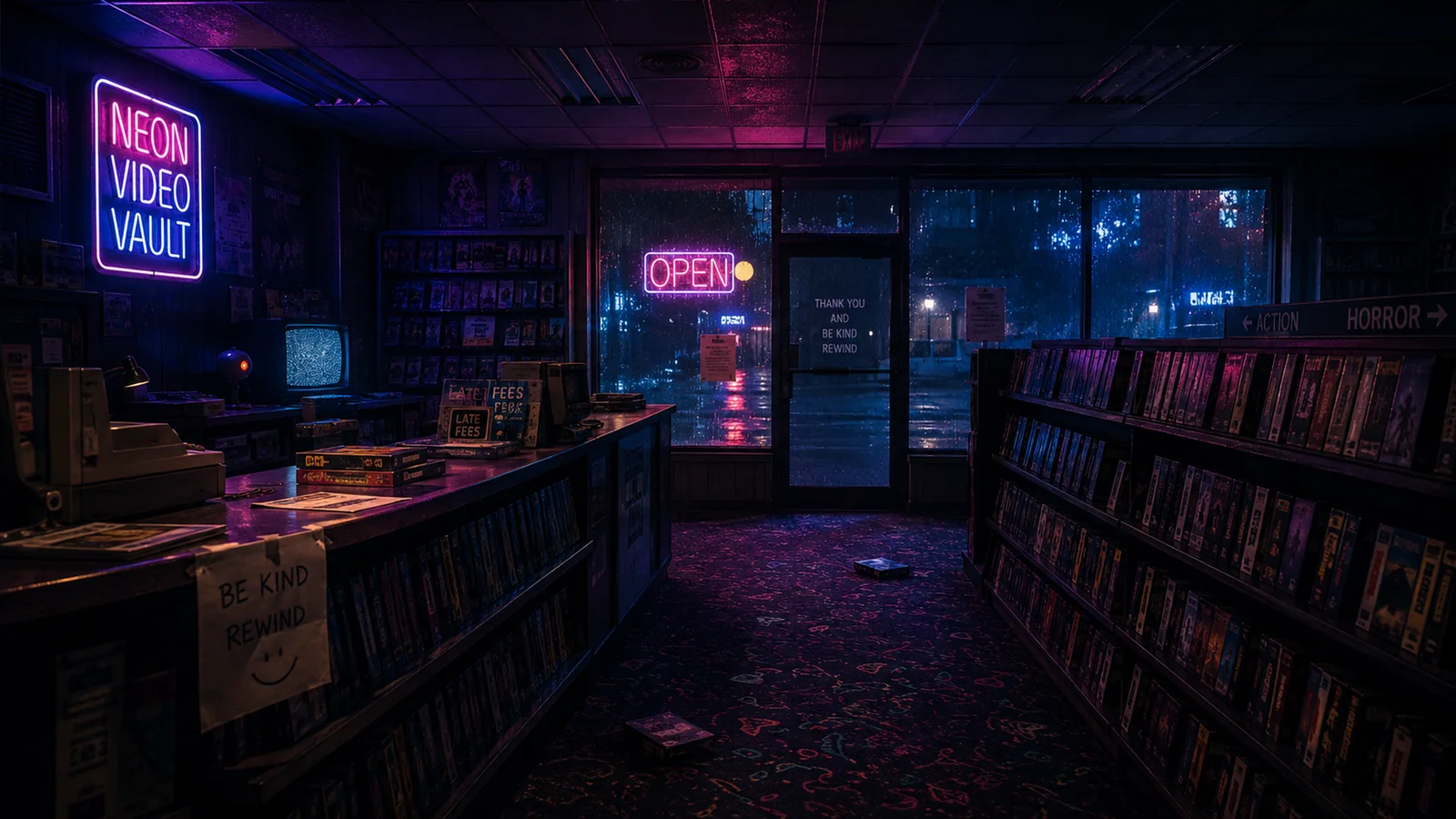
Rows of plastic cases, fluorescent light and the pressure of choosing one world before closing time.
Atmospheric reconstruction · Original NMA editorial artwork
Friday evening has already begun, but the film has not been chosen. Behind a plastic case, a small card or cassette indicates whether the promise on the cover can actually leave the building. The new release everyone wants is gone. That disappointment does not end the night. It sends the group deeper into the shelves. The scene is not important because everything was better. It is important because the experience had a shape. Waiting occupied time. Objects occupied space. Choices left traces. Even mistakes became part of the route. Already, the same result may arrive more quickly and with fewer visible steps. That is usually an improvement. But when the steps disappear, the knowledge, rituals and small social negotiations around them can disappear as well. This is the story of a Friday-night video-store visit in 1996: how a lost weekly ritual turned limited information into anticipation. It begins with an object or place that once looked completely ordinary, before time turned it into an archive.
By 1996 the ritual felt established
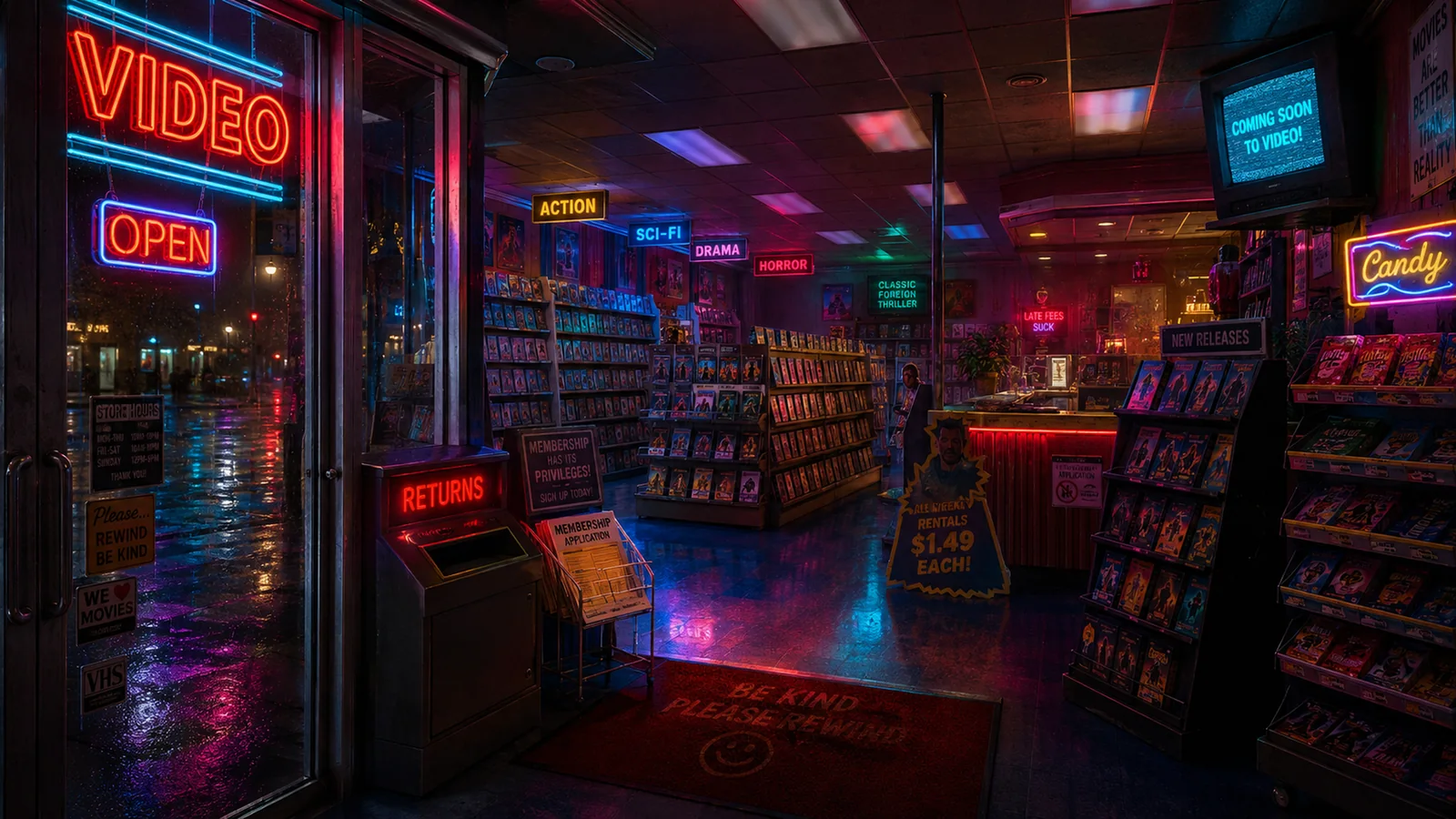
Imagine fluorescent aisles, carpet, rows of VHS cases and a new-release wall with empty spaces. The object is ordinary here, which is precisely why it matters. A launch date can mark a product, but adoption happens more slowly, through shops, gifts, workplaces and conversations between people. Large chains and independents organised new releases, genres and promotions around a mature VHS rental market, while DVD had not yet become ordinary. The idea became real through a sequence people learned by repetition. By 1996 the ritual felt established changed the user's next move. The ordinary task was to browse boxes, negotiate one choice, present a membership card and remember the return time, but repetition turned that task into confidence. A labelled case, memorised sequence or patient second attempt could matter more than an impressive specification. The same design did not offer the same freedom to everyone. The familiar version belongs to only part of the audience. Different prices, bodies, households and markets produced different memories. The ritual included late fees, inaccessible stores, transport, age restrictions and a catalogue shaped by local business decisions. Nostalgia can record attachment without proving universality. The arrival detail matters because limited physical choice made selection part of the entertainment. Packaging carried more weight when previews were limited. The next change becomes visible in the box was the primary interface.
The box was the primary interface
Return for a moment to fluorescent aisles, carpet, rows of VHS cases and a new-release wall with empty spaces. Nothing in the scene announces that it will later become history. Shape, colour, labels and moving parts taught the user what could be touched and what had to be handled carefully. Cover art, synopsis, cast, rating and staff stickers carried the decision because customers could not instantly sample every title. Daily use gave this technical detail a recognisable rhythm. Mechanism became habit here. People learned to browse boxes, negotiate one choice, present a membership card and remember the return time, often by watching somebody nearby rather than reading formal instructions. Success was remembered through the action that produced it, while failure taught a different version of the same system. Price, place and personal circumstance altered this part of the story. It is tempting to turn familiarity into a general rule. That would hide people for whom the system was unavailable, confusing or physically difficult to use. The ritual included late fees, inaccessible stores, transport, age restrictions and a catalogue shaped by local business decisions. The difference is part of the history, not a footnote. The design detail matters because limited physical choice made selection part of the entertainment. One choice required negotiation. From there, the story moves towards inventory lived behind the display.
Inventory lived behind the display
Look closely at fluorescent aisles, carpet, rows of VHS cases and a new-release wall with empty spaces. The remembered future is built from details this modest. The mechanism translated an invisible process into delays, noises and small physical signs that users gradually learned to read. Cases, tags, cards or actual cassettes indicated availability, connecting shelf browsing to a local stock system. For the user, the change appeared first as a practical routine. This part of the story can be measured in gestures. A user would browse boxes, negotiate one choice, present a membership card and remember the return time; then wait for a response and decide what it meant. The pause created room for anticipation, diagnosis and the quiet pride of knowing what to do next. That remembered convenience depended on conditions outside the object. Every convenience described here rested on conditions: ownership, compatible equipment, time and permission to use it. The ritual included late fees, inaccessible stores, transport, age restrictions and a catalogue shaped by local business decisions. Remembering the pleasure honestly also means retaining those boundaries. The operation detail matters because limited physical choice made selection part of the entertainment. The return deadline gave the evening an ending. A closer look at the first aisle created possibility reveals what followed.
The first aisle created possibility
Begin with fluorescent aisles, carpet, rows of VHS cases and a new-release wall with empty spaces. This small scene gives the history a human scale. People rarely remember a specification sheet. They remember the first successful moment and the room in which a new possibility became real. Entering a room full of visible films made abundance feel physical, even though the store held only a narrow selection of cinema history. The mechanism mattered most when it entered an ordinary day. The technical fact entered daily life through routine. Someone still had to browse boxes, negotiate one choice, present a membership card and remember the return time. Because the route was not completely hidden, users acquired practical knowledge about order, timing and care, even when they could not explain the engineering underneath. Not every household encountered this change from the same position. A household with spare media and technical help inhabited another version from one rationing time, money or access. The ritual included late fees, inaccessible stores, transport, age restrictions and a catalogue shaped by local business decisions. The object could be liberating and excluding at the same moment. The encounter detail matters because limited physical choice made selection part of the entertainment. Scarcity made browsing consequential. That practical detail opens the way to choosing consumed part of the evening.
Choosing consumed part of the evening
Imagine fluorescent aisles, carpet, rows of VHS cases and a new-release wall with empty spaces. The object is ordinary here, which is precisely why it matters. Repeated actions gave the technology a beginning, middle and end, creating anticipation that instant access often removes. Families and friends compared genres, age ratings, running times and previous disappointments before agreeing on one or two tapes. This was where an abstract feature became a familiar action. What looked like inconvenience also acted as an interface. The need to browse boxes, negotiate one choice, present a membership card and remember the return time divided the experience into recognisable stages. Each stage could be taught, shared, interrupted or remembered, giving the technology a rhythm of its own. The limits become clearer when the memory is viewed beyond one room. Regional releases and personal circumstances prevent one universal reconstruction. The ritual included late fees, inaccessible stores, transport, age restrictions and a catalogue shaped by local business decisions. The archive therefore holds several overlapping pasts instead of one perfect childhood. The ritual detail matters because limited physical choice made selection part of the entertainment. Packaging carried more weight when previews were limited. The same history continues through the missing copy redirected discovery.
The missing copy redirected discovery
Return for a moment to fluorescent aisles, carpet, rows of VHS cases and a new-release wall with empty spaces. Nothing in the scene announces that it will later become history. Capacity, battery life, bandwidth, fragility or time did not merely obstruct use; the limit influenced choices and attention. An empty new-release slot forced a second choice, giving older or stranger films opportunities an infinite digital menu may not reproduce in the same way. People understood the system through what it asked them to do. Ordinary expertise accumulated around the missing copy redirected discovery. To browse boxes, negotiate one choice, present a membership card and remember the return time was to participate in a sequence shaped by the device's limits. People adapted with notes, containers, favourite settings and advice passed across the room. Participation still depended on money, confidence and compatible surroundings. Even at its most common, the technology was not neutral. Design assumptions shaped who could operate it independently, and economics shaped who could practise. The ritual included late fees, inaccessible stores, transport, age restrictions and a catalogue shaped by local business decisions. The constraint detail matters because limited physical choice made selection part of the entertainment. One choice required negotiation. Its social consequences emerge more clearly in staff recommendations carried local trust.
Staff recommendations carried local trust
Look closely at fluorescent aisles, carpet, rows of VHS cases and a new-release wall with empty spaces. The remembered future is built from details this modest. Even a personal device depended on borrowing, teaching, showing, recommending and negotiating space with other people. Employees and handwritten shelves could connect regular customers to films through remembered taste rather than a platform-wide profile. Its meaning accumulated through small actions repeated over time. The user did not encounter the system as theory. They encountered a task: browse boxes, negotiate one choice, present a membership card and remember the return time. Over time the task became almost automatic, but its physical order remained available to memory long after the underlying product had disappeared. The familiar version was only one among several possible experiences. Memory often smooths away the barrier once somebody learned to cross it. Yet the barrier mattered. The ritual included late fees, inaccessible stores, transport, age restrictions and a catalogue shaped by local business decisions. The improvement offered by later systems should be judged alongside the ritual that was lost. The social detail matters because limited physical choice made selection part of the entertainment. The return deadline gave the evening an ending. The next layer of the experience is membership cards encoded belonging.
Sources & evidence
Documentary record
Wikimedia Commons / Family photos of Infrogmation
Open source record
Blockbuster Bend
Open source record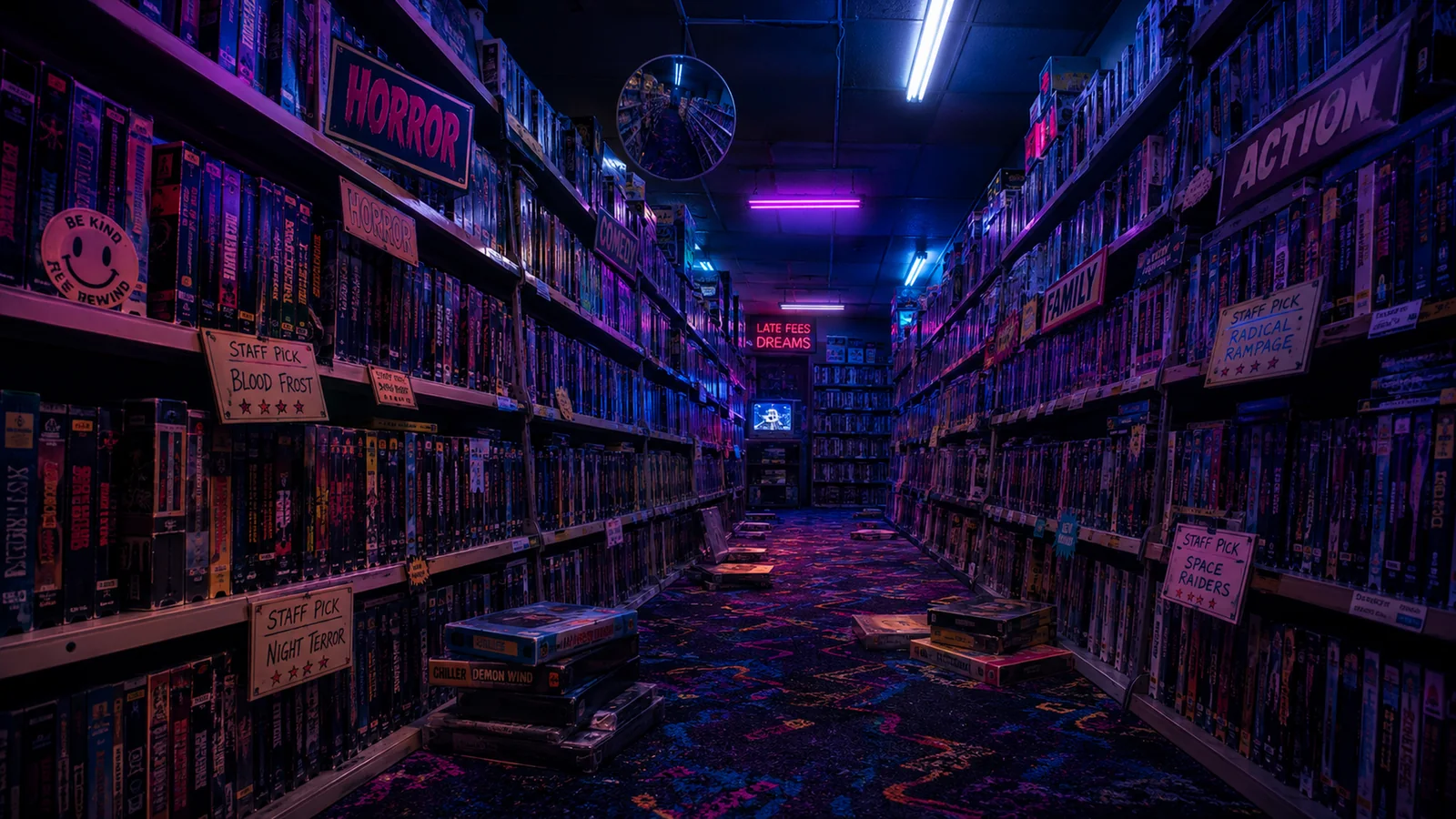
Membership cards encoded belonging
Begin with fluorescent aisles, carpet, rows of VHS cases and a new-release wall with empty spaces. This small scene gives the history a human scale. Buttons, errors, sounds and brand names became shorthand, allowing users to share knowledge before formal digital help was always available. Accounts linked names, addresses, rental histories and fees to a particular shop, making access both convenient and monitored. The everyday sequence made the larger change easier to recognise. The consequence appeared in behaviour. To use a Friday-night video-store visit in 1996, somebody had to browse boxes, negotiate one choice, present a membership card and remember the return time. The sequence made decisions visible: what to choose, what to keep and whether the result justified the effort. Knowledge lived in small repeated acts, not only in manuals. A different body, budget or household could produce another memory entirely. Access was never evenly distributed. Reliable equipment, money, language and patient help changed the experience, while shared rooms or inaccessible controls narrowed it. The ritual included late fees, inaccessible stores, transport, age restrictions and a catalogue shaped by local business decisions. The language detail matters because limited physical choice made selection part of the entertainment. Scarcity made browsing consequential. That language prepares us for the price included time.
The price included time
Imagine fluorescent aisles, carpet, rows of VHS cases and a new-release wall with empty spaces. The object is ordinary here, which is precisely why it matters. The remembered object sat inside a wider economy of wages, gifts, rentals, second-hand sales, blank media, subscriptions and repair. Rental periods, deposits, rewind expectations and late fees made the film a temporary object whose cost could change after checkout. What looked technical from outside became habitual from within. The price included time changed the user's next move. The ordinary task was to browse boxes, negotiate one choice, present a membership card and remember the return time, but repetition turned that task into confidence. A labelled case, memorised sequence or patient second attempt could matter more than an impressive specification. The pleasure and the barrier often existed at the same time. The familiar version belongs to only part of the audience. Different prices, bodies, households and markets produced different memories. The ritual included late fees, inaccessible stores, transport, age restrictions and a catalogue shaped by local business decisions. Nostalgia can record attachment without proving universality. The economy detail matters because limited physical choice made selection part of the entertainment. Packaging carried more weight when previews were limited. The economic reality comes into view through damage became a conversation.
Every neighbourhood store was different
Look closely at fluorescent aisles, carpet, rows of VHS cases and a new-release wall with empty spaces. The remembered future is built from details this modest. Markets, standards, broadcasters, electrical systems and household customs prevented one universal version of the memory. Catalogue depth, adult sections, local cinema tastes, transport and opening hours shaped the ritual more than one universal 1996 template. Here the wider history returned to one person using one object. This part of the story can be measured in gestures. A user would browse boxes, negotiate one choice, present a membership card and remember the return time; then wait for a response and decide what it meant. The pause created room for anticipation, diagnosis and the quiet pride of knowing what to do next. Regional and personal differences prevent one universal reconstruction. Every convenience described here rested on conditions: ownership, compatible equipment, time and permission to use it. The ritual included late fees, inaccessible stores, transport, age restrictions and a catalogue shaped by local business decisions. Remembering the pleasure honestly also means retaining those boundaries. The place detail matters because limited physical choice made selection part of the entertainment. The return deadline gave the evening an ending. Place complicates the picture in the store became Friday-night infrastructure.
The store became Friday-night infrastructure
Begin with fluorescent aisles, carpet, rows of VHS cases and a new-release wall with empty spaces. This small scene gives the history a human scale. At the cultural peak, the technology stopped looking remarkable and became background infrastructure for ordinary days. Food shops, takeaway counters and the journey home linked film rental to a larger weekly sequence. Normal use translated the design into a pattern people remembered. The technical fact entered daily life through routine. Someone still had to browse boxes, negotiate one choice, present a membership card and remember the return time. Because the route was not completely hidden, users acquired practical knowledge about order, timing and care, even when they could not explain the engineering underneath. The popular image becomes more honest when its exclusions remain visible. A household with spare media and technical help inhabited another version from one rationing time, money or access. The ritual included late fees, inaccessible stores, transport, age restrictions and a catalogue shaped by local business decisions. The object could be liberating and excluding at the same moment. The peak detail matters because limited physical choice made selection part of the entertainment. Scarcity made browsing consequential. At its cultural peak, the story becomes dVD-by-mail and streaming removed the trip.
DVD-by-mail and streaming removed the trip
Imagine fluorescent aisles, carpet, rows of VHS cases and a new-release wall with empty spaces. The object is ordinary here, which is precisely why it matters. The successor was usually faster, smaller or easier. Nostalgia becomes useful only when those improvements are acknowledged directly. Larger remote catalogues, postal services and on-demand playback solved availability and return friction while weakening the shared public browse. The practical ritual made the promise visible without explaining it. What looked like inconvenience also acted as an interface. The need to browse boxes, negotiate one choice, present a membership card and remember the return time divided the experience into recognisable stages. Each stage could be taught, shared, interrupted or remembered, giving the technology a rhythm of its own. Ownership was only one condition; time and permission mattered as well. Regional releases and personal circumstances prevent one universal reconstruction. The ritual included late fees, inaccessible stores, transport, age restrictions and a catalogue shaped by local business decisions. The archive therefore holds several overlapping pasts instead of one perfect childhood. The replacement detail matters because limited physical choice made selection part of the entertainment. Packaging carried more weight when previews were limited. What replaced it is easier to understand through rental ephemera preserves the local system.
Rental ephemera preserves the local system
Return for a moment to fluorescent aisles, carpet, rows of VHS cases and a new-release wall with empty spaces. Nothing in the scene announces that it will later become history. Hardware can survive while batteries, belts, services, displays, software and knowledge disappear around it. Membership cards, stickers, catalogues, receipts and cases reveal how a specific store organised access better than the film alone. By then, the operation itself had become part of the memory. Ordinary expertise accumulated around rental ephemera preserves the local system. To browse boxes, negotiate one choice, present a membership card and remember the return time was to participate in a sequence shaped by the device's limits. People adapted with notes, containers, favourite settings and advice passed across the room. Later convenience solved barriers that nostalgia can easily smooth away. Even at its most common, the technology was not neutral. Design assumptions shaped who could operate it independently, and economics shaped who could practise. The ritual included late fees, inaccessible stores, transport, age restrictions and a catalogue shaped by local business decisions. The preservation detail matters because limited physical choice made selection part of the entertainment. One choice required negotiation. Preservation brings us to the night began before play was pressed.
The night began before play was pressed
Look closely at fluorescent aisles, carpet, rows of VHS cases and a new-release wall with empty spaces. The remembered future is built from details this modest. The lasting memory comes from the relationship between a limited system and the imagination people supplied to complete it. The enduring memory belongs to anticipation: leaving home without knowing exactly which story would return with you. The final meaning rested on an action that once felt unremarkable. The user did not encounter the system as theory. They encountered a task: browse boxes, negotiate one choice, present a membership card and remember the return time. Over time the task became almost automatic, but its physical order remained available to memory long after the underlying product had disappeared. The closing memory must therefore hold both attachment and limitation. Memory often smooths away the barrier once somebody learned to cross it. Yet the barrier mattered. The ritual included late fees, inaccessible stores, transport, age restrictions and a catalogue shaped by local business decisions. The improvement offered by later systems should be judged alongside the ritual that was lost. The meaning detail matters because limited physical choice made selection part of the entertainment. The return deadline gave the evening an ending. The story now returns to its opening image.
Audiovisual archive
Watch the memory
The Last Blockbuster — Official Trailer
Official documentary-trailer footage of video-rental aisles, cases, counters and the surviving social ritual.
Open on YouTubeThe Rise And Fall Of Blockbuster
Documentary context for the scale and decline of the physical video-rental business.
Open on YouTube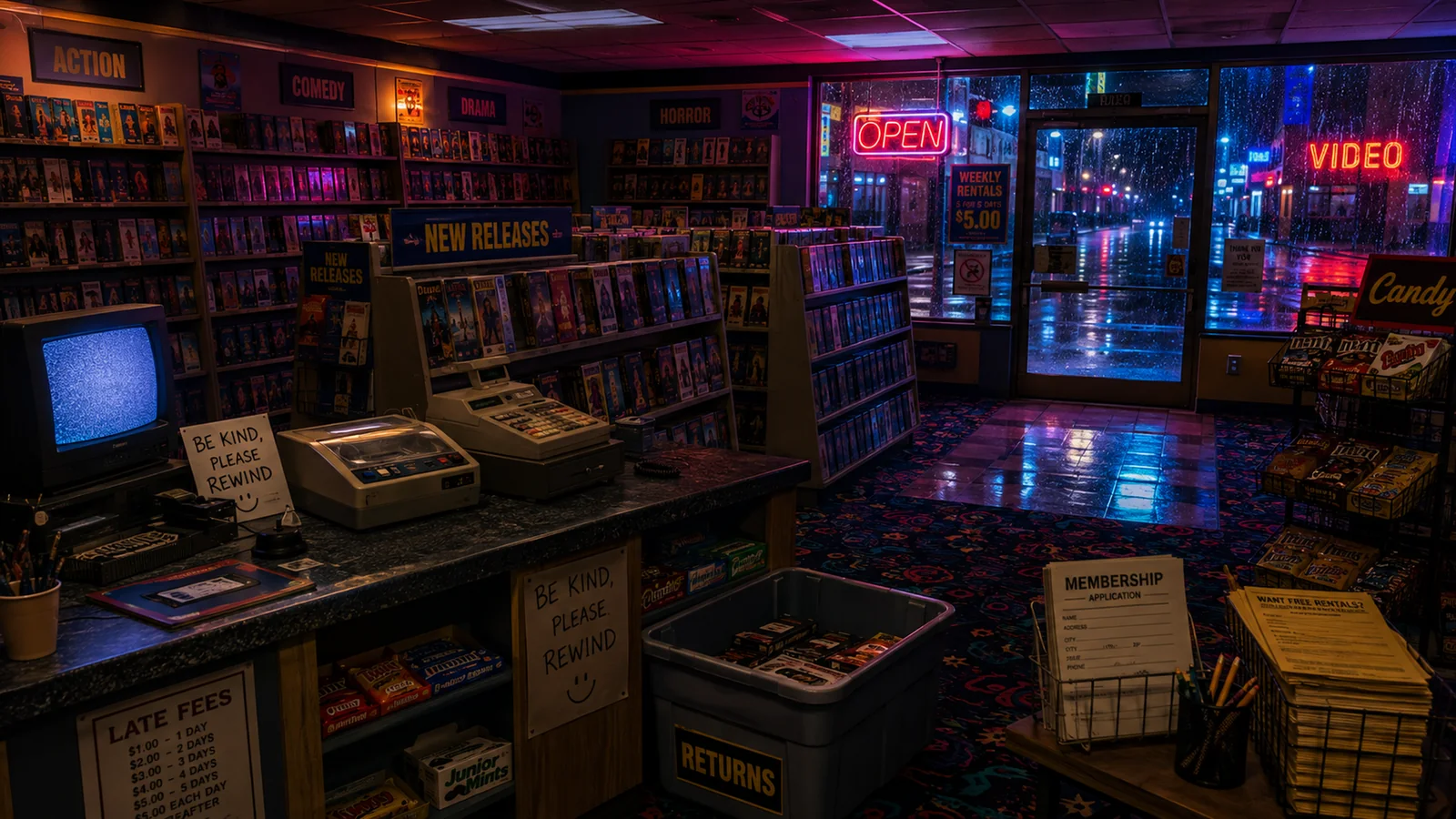
What remains
The cassette falls behind the metal flap after the shop has closed. The choice is over, the deadline met. Somewhere inside, it waits to become another household's Friday night.
a Friday-night video-store visit in 1996 did not vanish in a single moment. It became less necessary, then less visible, and finally old enough to be remembered as a world of its own. The successor removed genuine frustrations. It also changed the rhythm through which attention, anticipation and ownership had been expressed.
That is why the ritual survives. Not because every delay was precious, and not because every childhood had access to the same things, but because ordinary people built meaning around a limited system. They learned its sounds, its failures and its possibilities until using it felt like a small form of belonging.
The object may now sit silent. The place may have changed beyond recognition. Yet the old sequence can still return in an instant: a movement of the hand, a mechanical sound, a particular colour of light.
For a moment, the future is waiting there again.
---
Memory prompt
What detail do you remember?
Not the product alone—the room, the waiting, and the small rule that made the moment yours.
Archive note
This Memory File is open through the governed release registry. Reconstruction imagery is labelled separately from documentary references.