
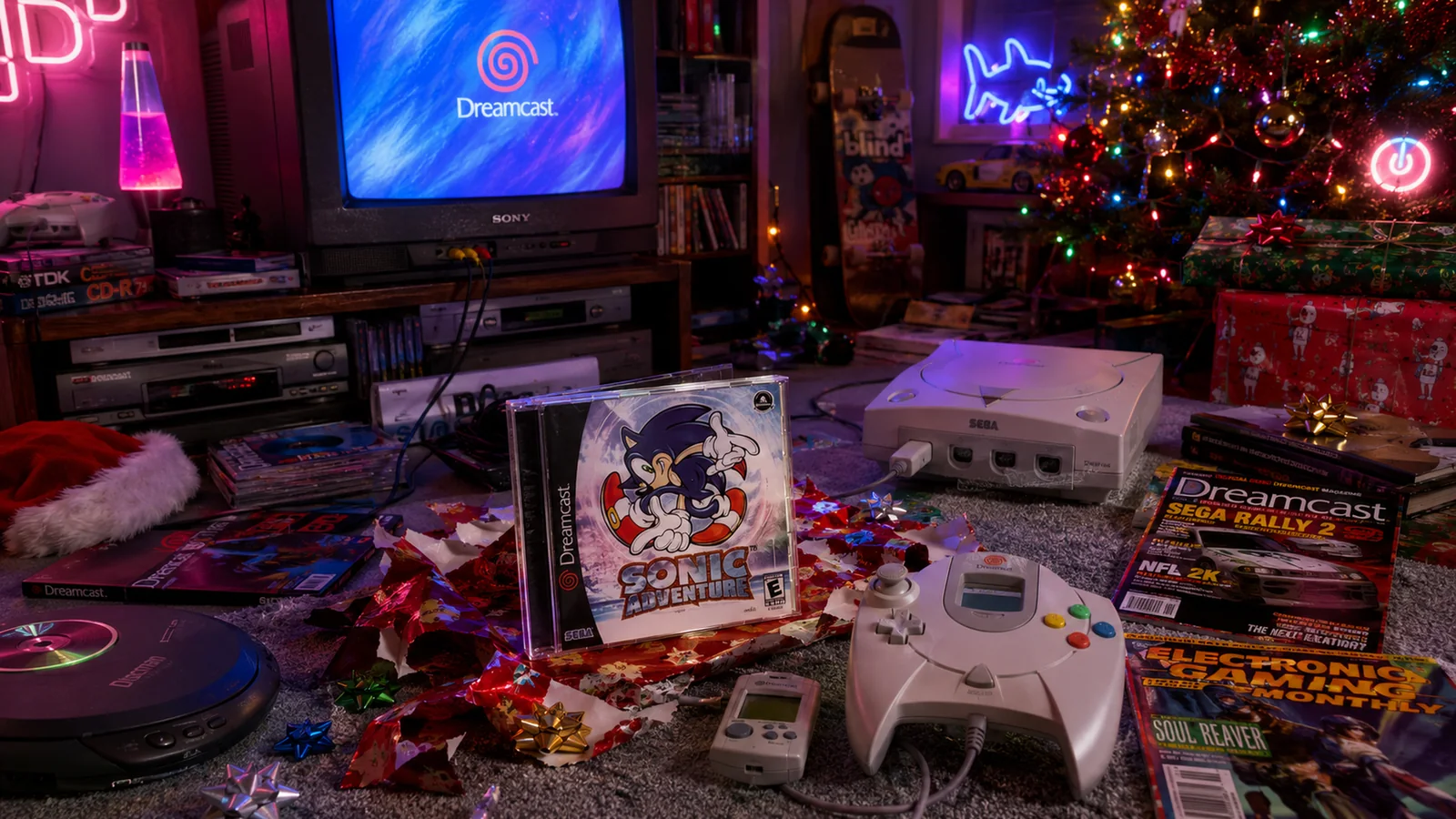
Memory File NMA-003 · 1988–2004
The Magic of Getting One Video Game for Christmas
One wrapped game, one winter morning and a world expected to last well beyond the school holiday.
Atmospheric reconstruction · Original NMA editorial artwork
Its shape had already suggested an answer. Too wide for a cassette. Too shallow for most toys. Just enough weight to contain a cartridge, a jewel case, or perhaps the game that had occupied your thoughts for weeks. So the package remained beneath the tree, surrounded by other shapes and by the ordinary furniture of the room. Each time you passed, you looked without appearing to look. A corner of paper had folded differently. The name on the tag was checked again. Perhaps the box was lifted briefly when nobody was watching, as though weight could reveal a title. On Christmas morning, paper gave way. For a second, only part of the cover was visible: a colour, a logo, the

Choosing the one game
A catalogue arrived through the letterbox or was collected from a shop. Its pages divided the year's possibilities into departments: toys, music, electronics, computers and games. Console sections were dense with small box images, prices and short descriptions that had to make an entire world fit inside a few centimetres of paper. Magazines supplied more detail. Reviews, previews and screenshots helped form a list that was rarely realistic in full. One title moved to the top. Another became the backup in case the first could not be found. A third remained present only because its cover looked impossible to ignore. A new game was not a casual addition to a library for many households. It could be a major present, something discussed between children and adults who did not necessarily understand why one title mattered more than another. The explanation had to cross a gap.
The long month before opening
Psychologists who study savouring describe the ways people attend to and extend positive experiences in the past, present and future. Anticipation can become part of the experience itself: imagining an event, discussing it and returning to it mentally before it occurs. There was a date. There was a desired object. There were weeks in which little could be confirmed. The calendar supplied milestones. School entered its final stretch. Decorations appeared in shops. Television schedules changed. Dark afternoons arrived earlier. Each sign moved the imagined game slightly closer. If the present had already been bought, clues might appear. A shopping bag was carried upstairs. A cupboard became suspiciously unavailable. One box beneath the tree seemed to have the right dimensions. None of this proved anything, which allowed hope and doubt to continue together.
Christmas morning has a soundtrack
Not music from the game, but the quick tear of wrapping, tape resisting, cardboard moving against the floor. Around it were voices, footsteps, a kettle, perhaps a television already playing somewhere in the room. Someone might be watching the unwrapping. A sibling reached for another present. An adult asked whether it was the right one. The answer could be obvious from the reaction before the title was said aloud. The box was turned over. Screenshots on the back were suddenly no longer distant evidence. They described something available now. The seal had to be removed without damaging the case. A cartridge was lifted from cardboard; a disc was pressed from its centre. The manual, if there was one, was opened before or during the journey to the television.
Sources & evidence
Documentary record
Nintendo
Open source recordThe Strong National Museum of Play
Open source record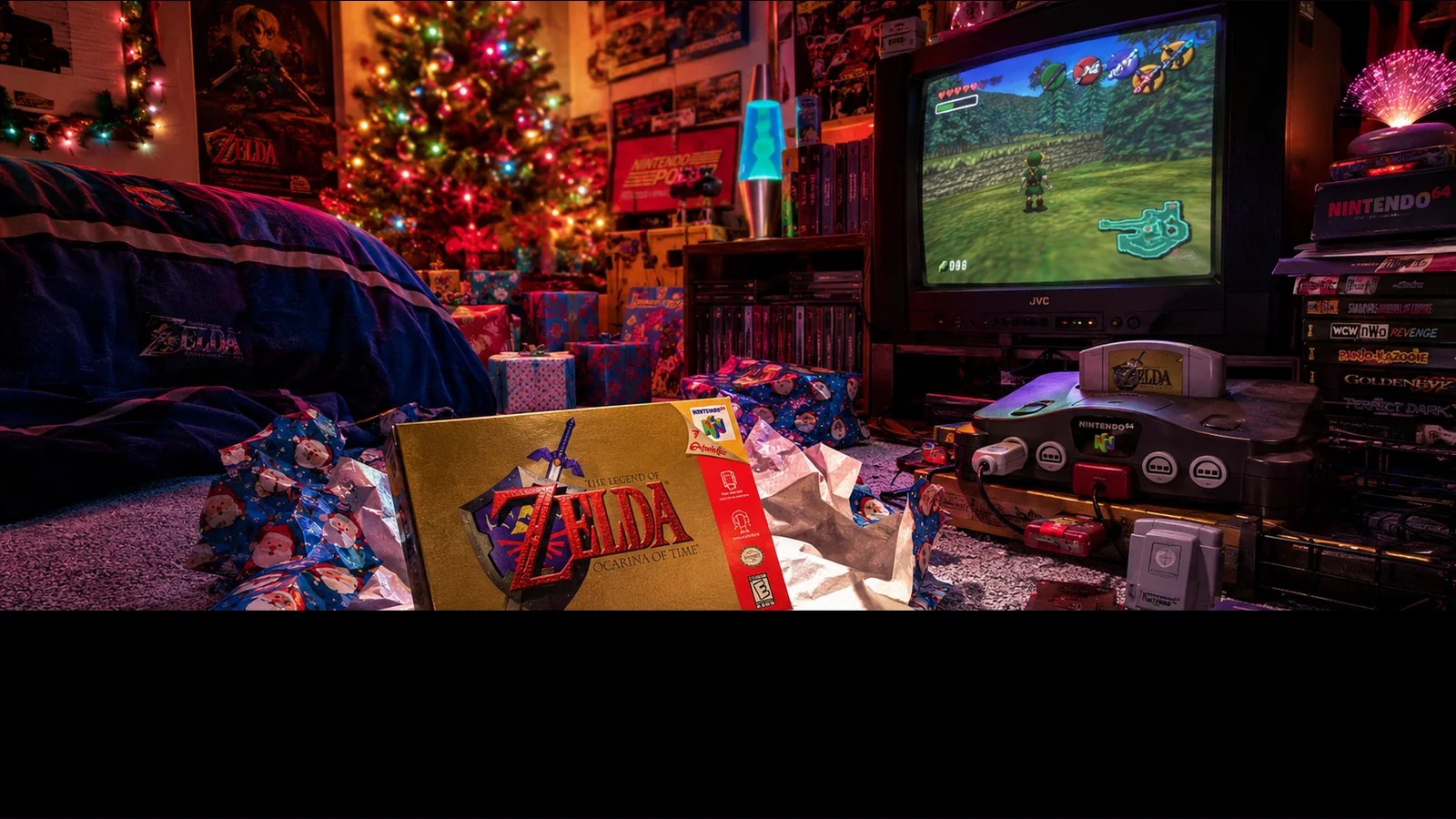
The game becomes the holiday
The new game had an advantage no modern design feature could guarantee. There might be older games on the shelf, but novelty gave this one priority. The request had been made, the waiting completed and the gift received. Moving quickly to something else would have felt almost impossible. Controls were learned slowly. Mistakes did not immediately become evidence that another game should be selected. A difficult section might occupy an afternoon. If progress stopped, the manual was consulted, a sibling was asked, or the same attempt was repeated until movement began to feel natural. The holiday offered an unusual stretch of days. School was closed. Adult routines changed. Even households without elaborate celebrations experienced a temporary rearrangement of time. Mornings and evenings could blur. A game started after breakfast might still be present after dark.
When the chosen game was wrong
Perhaps an adult had confused two similar names. Perhaps the requested game was unavailable. Perhaps the cover had looked exciting to everyone and concealed something awkward, punishing or simply dull. A gift represented money, effort and another person's attempt to understand. Saying that the game was unwanted might seem impossible. So it was played. This is one place where scarcity becomes less romantic. Having no alternative could force attention, but attention did not guarantee affection. A bad fit remained a bad fit. Some children spent a holiday trying to enjoy a game because the emotional rules of receiving a present required them to. Difficulty could soften through practice. An unfamiliar genre could begin to make sense. A title ignored in favour of the desired game might become more important later. Limited choice sometimes gave a difficult first impression enough time to change.
A memory larger than the cartridge
It might exist in a digital store, a subscription library or an emulator. Loading takes seconds. Guides explain every secret. The cover can be found in perfect resolution. None of this recreates the original Christmas. Memory stored the game together with a particular television, room and group of people. It included the cold colour of daylight outside, the position of furniture, the journey between relatives, and the temporary permission to stay awake longer than usual. This is why games without any seasonal imagery can feel deeply connected to winter. Their landscapes became the places visited during that winter. Their music filled the pauses in that house. A save point remembers nothing about the room, but the player remembers both.
What abundance changed
This abundance is valuable. It lowers barriers, preserves older work and allows players to follow curiosity without waiting for another birthday. A disappointing title no longer has to consume an entire holiday. When another game is always available, patience has more competition. A slow opening can be abandoned. Difficulty can be exchanged for a different experience. Discovery widens while concentration becomes a choice rather than a condition. The old Christmas ritual cannot be restored simply by buying a physical box. Childhood time, family structure and incomplete knowledge were part of it. Trying to manufacture scarcity can become another form of consumption. One game can still be chosen for a holiday. A library can be temporarily ignored. A manual or notebook can sit beside the screen. Progress can be shared with someone in the room instead of measured against everything else available.
Audiovisual archive
Watch the memory
Retro Video Game Christmas Commercials
A period-commercial compilation used as audiovisual context for the ritual of asking for and receiving one video game at Christmas.
Open on YouTube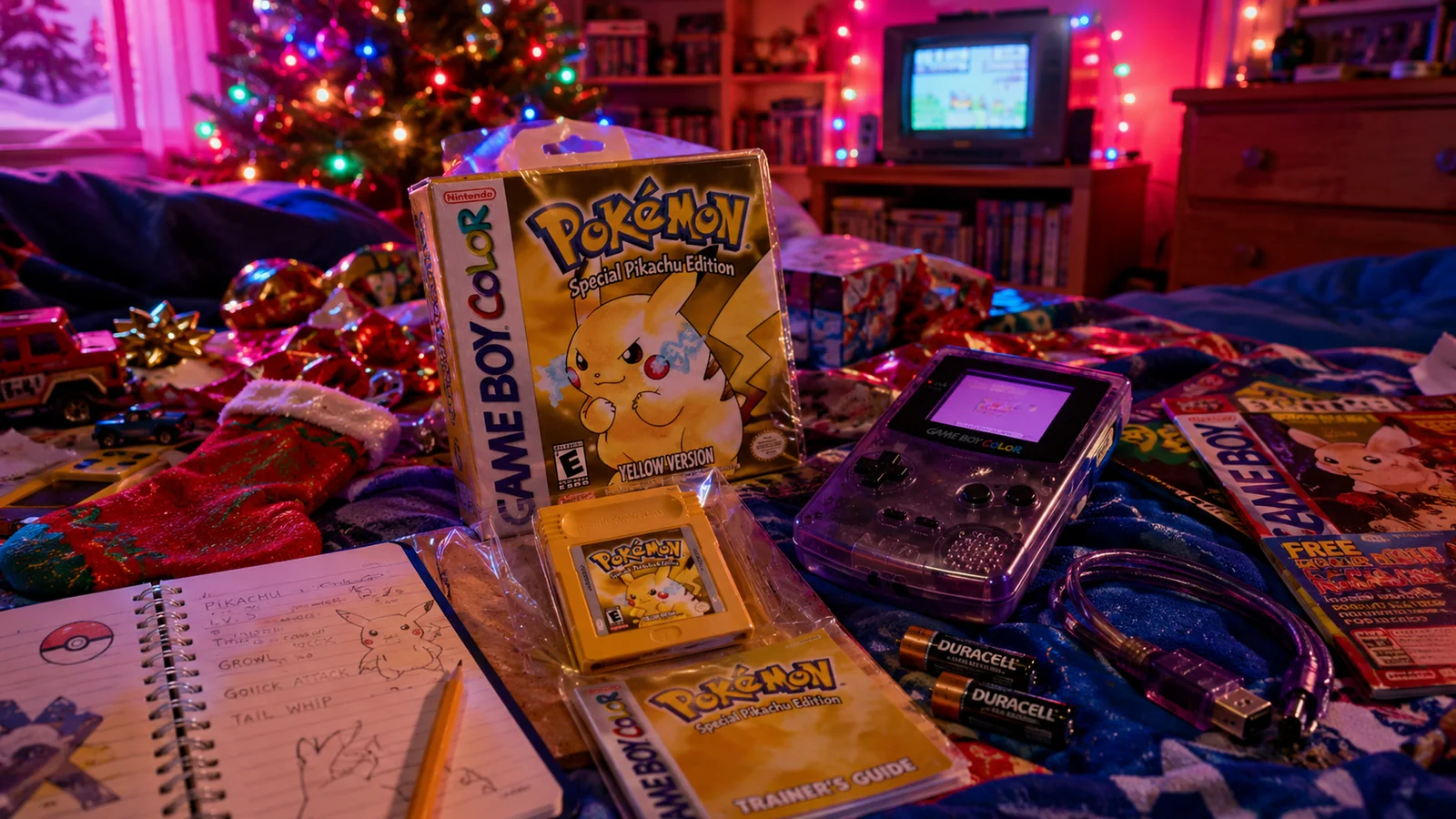
What remains
It held the catalogue pages, the repeated request, the possibility that the wrong thing had been bought, and every imagined version of the game that waiting had produced. The sound of the room. The people who watched. The first save. The argument over a turn. The dark afternoon outside. The days when one new game was enough to organise time. Decades later, the object may appear small. The world it once suggested was not. The present beneath the tree could never truly contain a whole Christmas.
Memory prompt
What detail do you remember?
Not the product alone—the room, the waiting, and the small rule that made the moment yours.
Archive note
This Memory File is open through the governed release registry. Reconstruction imagery is labelled separately from documentary references.